Background

Saturday, March 27, 2021

Sugar Rush

 I have loved sweets my entire life - chocolate, cookies, brownies, candy, ice cream, I was always up for dessert. I'd eat anything, provided I wasn't allergic: chocolate lava cake, tiramisu, fruit tarts, cookie dough sundaes, peppermint lattes, salted caramel truffles, and so much more. I've enjoyed ice cream for breakfast, and no, not just when I was having an especially bad day. On top of that, I love to bake, so for most of my adult life, I've had a recipe at the ready and (all too often) the spoils somewhere in my house. Even when I baked for friends, or to take to work, or whatever, I always still kept a little bit for myself. As I type this, there's both banana bread and cookie cake in my freezer. 

My thoughts have always aligned with the infamous joke about sex and pizza: Even when dessert was bad, it's still pretty good. 

As if to spite me (lol, like the universe cares that much), a global pandemic set in a year ago, and suddenly I had no one to share my baked goods with - no office, let alone office-mates to feed and/or bribe with lemon raspberry cake, blondies, cranberry cinnamon cookies.   Did I let this stop my baking habit? Of course not, except that now Bishop and I were the primary audience.  As I'm sure you can guess, this quickly spiraled out of control into a delicious disaster. 


No chocolate in my house was safe. 

In general, I have been very fortunate in the pandemic: My job in IT allows me to work 100% from home as well as keeps me gainfully employed.  Most of my immediate family was either the same, like my brothers, or retired, like my in-laws and my mother. My dad had Covid, but it was thankfully mild. Now, as vaccines roll out, working in IT has somehow added me to the priority list and Bishop and I are already one dose in, with the second scheduled soon. On top of that, my job throughout the last year has been relatively low-stress, allowing me to exercise regularly, cook more often, and generally stay sane.  I haven't gained a pound over quarantine; in fact, I've developed more muscle mass and walked more steps in the last year than probably the previous two combined. 

This is all, of course, while I've been stuffing my face with sweets. 

pictured: me March 2020-Feb 2021

I did eventually recognize that while, sure, I hadn't gained weight and of course I was enjoying myself, I was not in a healthy place. No meal was truly good for me if I chased it with a piece of cookie cake the size of my fist, no matter how many veggies were originally involved. 

This is when Whole30 got involved.  

I'd encountered it before, one of many diets that friends have tried or that popped up on one of the endless cooking subreddits I browse. I'd considered it before too, but the insanely restrictive rules seemed truly impossible when faced with my former office's glorious, never-empty pantry of cereal, yogurt, and coffee -- all things I am powerless to resist but require sugar to be fun. 

The pandemic, however, solved that problem - no temptation to eat a bunch of junk if it's not nearby, no restaurant difficulties to navigate if I haven't been in a restaurant in a year, no happy hours, birthday parties, or anything else to feel awkward (or wish for cake) at if all of those things simply do. not. exist. That, coupled with an ice cream cake for Bishop's birthday that a) was the size of a large pizza, and b) did not last a week in our home, which is just the two of us, and something had to change. 

So for the past month, Whole30 has been my life - I 'm on Day 27, 3 days and 9 meals (but who's counting) to go. Some days have been like this: 


but overall, it's been survivable. Black coffee, more eggs and brussel sprouts than I can count, and by the second week, all I really wanted in life was a grilled cheese, but it's almost done. I want to review it, to explain the inanities about American food it revealed, to rant about how dumb I find some of the rules, to excuse my mistakes, and to truly reflect on the benefits - because there have been lots, more than I expected even if they are wildly different from what I thought they'd be. 

I can't yet, because I'm not done. 

But also because I can't stop thinking about ice cream and chocolate easter bunnies, white chocolate raspberry crepes and cinnamon rolls, a real cup of coffee with cream and the blueberry lemon loaf I definitely should have baked before this misadventure started. 


Tuesday, April 14, 2020

Black Coffee and Sadness

I am training myself to drink black coffee. Because, you know, there wasn't enough bitterness in my life what with the pandemic and all.

Really, this all started a few weeks ago, when my ancient coffeemaker died.  It had served me well, providing far too much caffeine for far too little effort since I bought it for about $8 from a Costco in 2011.  It's been tossed into pantries and abandoned, lived through a classroom full of students abusing it, survived a career change that required SO MUCH MORE coffee than I ever anticipated, even clogged a few times, but it's always survived. Suddenly, ten days into a pandemic, and nope, time for the Little Coffee Maker Than Could to eat it.

I went to Target and bought myself a new one - a better one! - for a whole $20.

This coffee maker and I got along great for a few weeks - fresh, delicious, piping hot coffee that made the world feel a little better when it was cold and dark and awful (and not just in my house).

Then it went bad. Every cup tasted overly bitter, oily, burnt. Something was wrong - something that couldn't just be solved by cleaning the carafe, though that certainly helped.

It took me a few days until I figured it out: the creamer. My normal creamer somehow didn't get along with this new coffee maker -- the coffee turned to bitter, gross sludge. Maybe I'd added powdered vanilla caramel one too many times and the flavor rebelled. Maybe I'd tried to go sugar-free too many times and the coffee itself gave up all hope of tasting even remotely palatable. Whatever it was, every single cup was ruined.

Which brings me to yesterday. 

Yesterday, after my first cup of disgusting coffee was poured down the drain, I realized I still had half a carafe that was hot and, more importantly at 8am, caffeinated.

I poured it in a mug and stared at it for a while.

I've never liked black coffee - it tastes too much like punishing myself first thing in the morning, and if I'm going to do that, I may as well work out instead.  Sure, I've been teased over the fact that really, I'd prefer my caffeine in the form of a candy bar in a cup (aka, a skinny white chocolate mocha, and no, the irony is not lost on me). Sure, I've struggled to find tolerable gas station coffee that I can stomach while on road trips or vacations in order to stave off the headache long enough to make it through the day.  But I've never given up on creamer and so much sugar that it makes other people cringe from across the room.

But yesterday... I knew. I had to make the effort. I was drinking too much coffee every day, and it was so bad, that there was no way black coffee could possibly be worse.

I took one sip and promptly realized how wrong I was.

That said - it was still better than whatever unholy concoction I'd made and thrown out the day before, so I decided to see what I could do.

After scrounging around my nearly-empty (read: only vegetables and fruit left, what a crisis) pantry and fridge, I located a container of half and half and a couple of sugar packets. Hm. Once the sniff-test deemed the half and half acceptable, it was go-time.

About a tablespoon poured into the mug, tendrils of creamer roiling through the hot coffee. I stirred and stared - could I do it?

Nope - needed more empty calories. I added a sugar packet, stirred again, and finally took a sip.

It was pretty good.

A feeling of immense pride swept over me: I was drinking my coffee black. Well, black for me - it wouldn't give me diabetes on impact nor would it cause me to spontaneously throw up, so that qualified as a win in my book.

This morning, I repeated the experiment -- perhaps my results yesterday had been skewed. Perhaps the quarantine was getting to me. It seemed almost reasonable that I'd hallucinated a nearly-plain cup of coffee and had instead driven myself to the only open Starbucks in my city.

So I tried again -- the same tablespoon of cream and a single sugar packet, and I was bopping along, happy as Zipper on Bunny Day on a deserted island while I tried to intelligently interrogate my new coworkers on our clients and their projects.

Even while typing this, I remain proud of myself - this is growth! I've never enjoyed black coffee in my life! Could this be it? Have I made a breakthrough?

Only time, and the continued sadness of being trapped in my house, and quite a bit more mostly-black coffee, will tell.

Thursday, April 9, 2020

New Job, Global Pandemic - NBD, Really

In the midst of a global pandemic, I started a new job.

It's not like I did this on purpose. I wasn't just bored and said to myself, "Well. I don't have enough stress and chaos in my life, let's throw that secure job out the window and try something new!"  But, through a combination of organizational change, conflicting schedules, and someone apparently eating a bat(?), here I am.

It's just as scary as I thought it would be. There's the normal first day stress - what do I wear, who do I ask for help, how do I know I'm doing the right training or attending the right meeting.

There's also what I'll call WTF Pandemic Stress.

Some WTFPS is just an amped-up version of normal first day stress: What do I wear when my orientation will be remote? I'll have to turn the webcam on - Do I need a suit jacket? or pants? Okay, yes, I definitely need pants - are jeans okay? Should I be wearing shoes?

But most WTFPS is bizarre, WTF am I doing, stress.  For example:

  • Literally everyone at the company is working from home - I can't wander the office halls until I find someone who can give me some direction. Do I just ping random people until I find someone who can help me? There are close to 2000 people at this company - that seems like a terrible idea. It may become necessary. 
  • I have no idea who my boss is - like, none. I think maybe I have two? or three? Someone who is my "team coordinator" reached out, but they specifically called out that they are not my manager. The person who is most likely to be my manager can't meet with me until next week. Who am I supposed to be taking direction from? 
  • How do I know what this company is actually like? Usually the first week is key - is everyone laughing and chatting, or is the office silent? Do engineers have stickers on their laptops? Are people silently rolling their eyes when I ask for help or not? I NEED BODY LANGUAGE TO UNDERSTAND PEOPLE. 

WTFPS also works against the seemingly positive things about this new job and its weird remote orientation.  Everyone I've talked to so far has been super sympathetic and kind - is this normal? Would I be told to relax and take things at my own pace if I were in the office? Should I feel bad that my motivation is low because I'm sick of being trapped in my house and I mostly want to play Animal Crossing while I listen to training videos?

There's no remote equivalent of being in the office, especially right now. There just isn't.

Am I being paranoid? Probably. Is it justified? Again, probably.
This is a global pandemic. Why tf am I starting a new job again?

Sunday, May 20, 2018

No Easy Answers

Back in February, I got a new job.

It was not something I was expecting -- one minute, I was planning on leaving after six months with the company, and the next, I was recruited off the help desk and into an actual career path I hadn't even known existed.

I'm a Business Analyst now, working with the development team of the same company that first took a chance on me last year.  My days are filled with requirements and use cases and acceptance criteria, with solving problems and studying and incredibly dry textbooks -- so like what I was doing before I moved into IT, before I changed my life.

It feels very similar, but I have to hope it won't take 150 hours of outside-the-office work to feel capable (like last time).

In transitioning to a new team, I've gained back some of what I thought I'd lost when I left teaching.  Suddenly, there is more laughter in my day.  I tolerated most of my coworkers, but I genuinely like the developer on my team, who loves musicals and dogs and is just as sarcastic as I am.  I like the head of AppDev, who is nerdy and drives a sweet car and loves to talk about anything, like I do.  I love my boss, who is enthusiastic and energetic and so positive it's almost overwhelming.

Suddenly, I'm surrounded by people for whom technology is a passion, not just a job.  I love it.

And even if I don't love the mission of my company, I was prepared to keep right on going until I hit a year or more of experience.  I was prepared to keep learning and practicing and getting better until I was more than qualified to find a new gig at a bigger, more likable company.

Until last Thursday.

Last Thursday, my boss announced she was leaving.  June 1st is her last day.

As is easy to imagine, this threw me for a bit of a tailspin.

I genuinely like my boss.  She spent months giving me advice and direction for how to improve my skills while I was bored on the help desk.  When the opportunity arose for her to create a business analyst position on the dev team, she jumped at it -- and convinced upper management that I was the right person for the job.  She has spent countless hours with me doing training, finding resources for me to learn, and giving me feedback to help me grow.  She's even funded my membership to two professional organizations, including a local one so I can get involved in my field.

On top of that, she's spent the last two months building our dev team into one worth working on.  She's built a great data services team, recruited an App/Dev manager who is an expert in the field, and found some awesome devs to actually do the work.  She's protected us from unreasonable requests from leadership, helped us navigate some truly awful deadlines and expectations, and through it all, she's talked up how much amazing work we are doing.

In all, she's an incredible person, and I love working for her.

Now she's leaving.

It shadows my whole future with question marks -- Just how much did she protect us from the mess of senior leadership?  What's about to happen with the dev team? With my BA training?  Should I leave?  Will someone hire me when I only have six months experience  in the field? If I don't leave, can I tough it out, or will it send me straight back to the same disastrous mental health issues I'd finally left behind?

There are no easy answers.

As much as I love her, her decision is a little cutthroat too.  Our new App/Dev manager joined the firm less than a month ago, wooed away from a long career as a dev and a consultant by my boss.  The primary developer on our team took the job on a recommendation from a friend on the data services team, which my boss ran.

And without her intervention and support, I would have been gone months ago.  It was never that I loved working for a semi-shady law firm; it was that working with her made it worth it to stay.

We have a built a team here, and suddenly our fearless leader is leaving.

She wants me to go with her.  Supposedly, her new company has an open business analyst position, and she wants me to apply.  She's talking me up to her recruiter and manager, trying to get them to see what she sees in me.  I'm flattered, really --  having someone else so invested in my career is strange to say the least.  But I also don't know if it'll happen.  Her company is a big one, and big companies don't always like to take chances on young careers.  If I'm lucky, they might.  If I'm really lucky, all those question marks will dissipate into some very solid, high-dollar exclamation points.

Like she already has, my boss could change my life.

But it's slow going, like everything in corporate America, and instead for the next few weeks, all I can do is learn as much as possible and hope that maybe, just maybe, my new job can be my future one, too.


Saturday, February 17, 2018

Computer Literacy, Not Coding

Lately it seems like all anyone is talking about is coding.

It came up in at least three of the four job interviews I had to get my current job.  Two of the three people interviewed in a recent TimeMoney article as examples of long-term unemployment are learning to code to beef up their resumes.  Google routinely sponsors “Learn to Code!” webinars on their homepage or as events in the year.  Every local library offers learning to code classes for beginners.  There are even toys that use Star Wars as a platform to teach kids to code. 

It is a skillset hailed as the cure-all of the modern world, solving problems from students lacking math skills to unemployment.  Resources everywhere suggest learning to code to boost your desirability as an employee, to keep your mind sharp as age advances, to boost the amount of money you can make. 

For someone in IT, it is frankly confusing. 

Few of these articles mention computer skills in a broader sense as necessary – it is possible this goes unspoken, but considering how many phone calls my help desk receives that are “how do I change the time on my computer,” I suspect that it’s simply been overlooked.    

More often than not, these articles are filled with statements designed to draw and please audiences.  They talk about how desirable coding is as a skillset, how much money a developer can make.  Sometimes they tell one-in-a-million stories about employers competing over coders, sending their salaries sky-high.  Most mention, at least indirectly, those most famous programmers who have made millions with a new product – Mark Zuckerberg comes to mind, along with basically the entirety of Silicon Valley (the place, not the show). 

It’s not that all of these things aren’t true.
 
Sure, if you learn to code, you could make a shitload of money.  You could end up being pursued aggressively by employers.  You could invent a new app and run your own company and make millions. 

But before you do all that, you have to actually learn to code. 

Almost none of these articles mention just how time-consuming and truthfully, hard, coding actually is.  Most, instead, point toward coding boot camps or small start-ups that will walk a new coder through a lot of small, easy-to-write/understand programs.   They’re full of encouraging statements like “Everyone can code!” or stories about people learning to code in retirement, as if that somehow makes it easier.   Some courses, like those on Udemy or Pluralsight, offer more comprehensive looks at coding, but even then, they often start with blindfolds and hand-holding, hiding just how difficult this skill is to acquire. 

Everything starts easy – the traditional “Hello, World!” console program (below),

a calculator, a rudimentary coin-flipper, all those little baby programs that make this seem really easy and possible.  Sure, everyone can learn to code when it’s just a few lines!

But, as with most things, it’s not that simple. 

Coding is, essentially, syntax combined with algebra.  How you put statements together, how you declare variables, and how you set your methods to run (all extremely basic tasks in C#, for example) is all about how you set up the computer to read your code. 

If you are like me, and Algebra 1 threw you back in high school, this seems near-impossible.

There’s a lot out there about how to learn to code, but the one resource that has always stuck with me is Viking Code School’s article “WhyLearning to Code is so Damn Hard.”  It has a handy graph to outline the process: 

That graph alone is enough to scare people away – the 'desert of despair' does not sound particularly welcoming.   Hell, listening to Bishop talk about hours or days at work spent running down the smallest of bugs makes me want to cry with frustration on his behalf. 

So the notion that everyone should learn this skill baffles me. 

Apparently, I am not alone. 


Last May, just as I was leaving teaching, I found myself briefly unemployed.  It didn’t last long – all told, about three weeks, one of which was just me waiting for my start date to finally arrive.  But like so many others who find themselves unemployed, I considered that maybe I should learn to code. 
Bishop set me up with a beginner Udemy course he’d used and I was off and running. 

For about an hour.

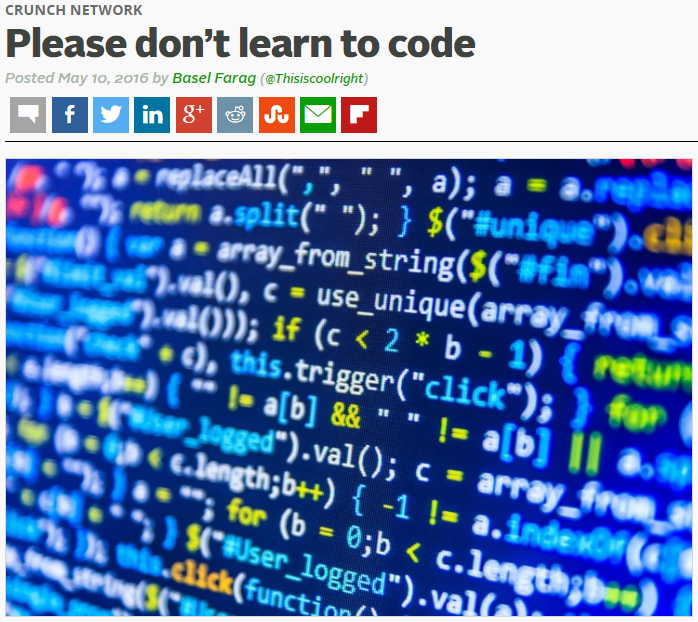
Then, stumped by the fact that coding is algebra conducted in Latin and I sucked at both, I started playing on the internet.  Within minutes of googling about coding, I stumbled upon the Tech Crunch article above, titled “Please Don’t Learn to Code.” 

It argues that, while coding is a useful skillset and our current economy does need people able to do it, providing the entire populate with these skills is wildly unnecessary.  At one point, the author says, “I would no more urge everyone to learn to program than I would urge everyone to learn to plumb.”
 
I know there are those who would argue that everyone should learn to plumb.  Resist that urge, just for a moment. 

Instead, the author argues for better problem solving skills – after all, someone can code to their heart’s content, but if they don’t understand the problem they are solving, coding a solution is pointless.  You can’t fix a bug if you don’t know why the bug is there in the first place.  Those skills are the ones that are truly lacking – the ability to figure out what’s going on, to ask the right questions, to fumble through and find a solution that works – and all that has to happen long before anyone can whip out a variable and assign it a value. 

Having read this, and having helped students, family members, and more fix computers for years, and having spent just a smattering of time in the industry, I can safely say that coding is not for everyone. 
 
Everyone does, however, need computer skills.  That’s just the world we live in now – just about everyone will interact with a computer almost daily, in some form.  And those problem solving skills that Tech Crunch wants us all to have are only sharpened by learning how to solve all kinds of small computer problems.

Instead of coding, what I would argue for is computer literacy. 

I just left teaching – I’m still so close that I write lesson plans in my head while I brush my teeth and have active shooter nightmares.  I’ll build you a curriculum right here:

Unit 1: Working a Computer: Hardware
  • Parts of a computer: motherboard, processor, hard drive, RAM, and more
  • How to build a computer
  • Never leave the computer on all the time
  • Why pressing the power button to turn it off is a terrible idea
  • Don’t just yank out a jump drive
  • Fix it vs. Replace it: Pros & Cons

Unit 2: Working a Computer: Software
  • Basic Programs: How to set up email, word processing, online storage, etc
  • Strong Passwords
    • What a strong password actually IS
    • Resetting a password
  • Why having a million things open makes things slow
  • Changing the date, time, program defaults, and more
  • Adjusting the volume

Unit 3: Basic Internet Skills
  • What the Internet IS
  • Set up a rudimentary network; protect that network
  • Resetting a router
  • THE Cloud is not A cloud
  • How to google properly
  • Reliable sources
  • Using quotes, +, and more to tailor search results

A creative teacher might even use parts of College Humor's "If Google Were a Guy" videos  (NSFW, but very funny).

Unit 4: Basic Security
  • How to avoid dangerous websites
  • How to protect a home network
  • What phishing, ransomeware, spyware, and more actually are
  • What Not to Click On in email, online, and more
  • Never open email from an unknown source
  • Never give out passwords or personal info over the internet
  • What to do when if your email is hacked

Unit 5: Peripherals
  • How to install a keyboard, mouse, jump drive, printer
  • How to set up wireless anything: Bluetooth speakers, headphones, etc
  • How to install a wireless printer

Somewhere in here, people also need a lesson on “How to Be Nice to Tech Support When You Call Them.”  Too many people call my help desk and are already shouting when I pick up the phone.  They are ignoring the fact that I have literally All The Power over their computer.  Do not fuck with the IT people. 

But I digress. 

I even have the perfect time in high school: junior year, maybe opposite Personal Finance, so they have experienced some of these things but haven't yet totally checked out of school.  The final could be sitting them down in front of a computer that is all kinds of screwed up and telling them to fix it.  And disabling Google beforehand – Google is any good tech’s best friend. 

#IndustrySecrets
Some of this probably sounds painfully straightforward, but trust me, it is not.  In six months on a help desk, I have had to explain how to minimize windows, that files are different sizes and why that matters, how to turn the volume up, and why leaving your computer on for a month is a terrible idea.  People do not understand. 

Sure, sometimes, I wonder if anyone would trust the lawyers of the firm I support with their cases if they knew some of the ridiculously simple computer issues they can’t fix.  And the fact that someone will call me and brag that they don’t get computers so they’re keeping me employed does make me want to kill them.  I’m just not sure it’s 100% their fault. 

So much of our world runs on technology – smartphones, tablets, laptops, smart watches.  It is easy to assume that, since technology is ubiquitous, everyone knows how to use it.  For years I heard teachers say that kids should know how to use a laptop because they are always on their phones. 

But using something and using it correctly are not the same. 

After all, no one wants to be like one of my coworkers, who was trying to code something and accidentally deleted all his system files.  You know, the ones that let the computer turn on and load an operating system. 

Of course without some computer literacy, people probably don’t quite know what it means to load an OS, so perhaps I’m getting ahead of myself.

We can't have everyone coding until everyone can actually use a computer -- and let me tell you, almost no one can actually use a computer.


Saturday, November 4, 2017

If I Start Wearing Purple at Work, No One Will Get It

Last week, I fulfilled a years-old curiosity: I went to see Gogol Bordello.

If you've never heard of them, Gogol Bordello is a Gypsy punk rock back from NYC, and they sound exactly like you'd expect from that description.  If you've heard of them, it's probably for "Start Wearing Purple":


Just about every tattoo parlor I've ever been in has them playing on repeat in the background. They've made documentaries about their band and added their bizarre sound to a variety of eclectic movie soundtracks, and they have more band members than I have fingers.  Years ago, the frontman was the lead in the movie Everything is Illuminated, opposite Elijah Wood, and spent the movie (as far as I can tell) being himself.

The band lives for the stage; they tour relentlessly, almost nomadic like their Gypsy-inspired sound, and they are known and loved for their on-stage performance and energy.

Even though I can only name the one song, I've always wanted to see them.  They live as a constant presence in the back of my mind, all tumbling chords and pounding drums and cheerful accordions.

So when I got the opportunity, I bought tickets immediately.  Poor Bishop -- he didn't have a choice; he was going too.

We drove to the venue a few nights ago with the same repeated sentiment: This was an experience.  If the show was awful, we'd leave, but we needed to see them.  Needed to experience it, just to see what it was like.  If the Wikipedia stories of their insanity were true.

They were.

By the second song in,  frontman Eugene Hutz had produced a bottle of wine from somewhere and proceeded to tear the cork out with his teeth.  He waved it around as he danced, unbuttoned-to-his-waist shirttails flying, while next to him, a 70 year old music professor positively wailed on his electric violin.  By the end of the concert, he'd broken half the horse hairs of his bow.

By the fourth song, their second-best known called Wonderlust King, the little kids and the braless women surrounding us were losing their shit dancing, the kids up on the table next to us as their parents danced behind them.  The according player on stage stood on top of the speakers and made faces at the audience while he gave Weird Al Yankovich a run for his polka-loving money.

The opera singer came out next, wearing a steam-punk floor-length orange leather jacket over leggings and binoculars, her stunning voice soaring over the Russian pouring from Hutz's mouth.


Then came the brass section, four guys in white shirts and Beetlejuice-stripped black and white pants that I quickly realized had been hanging out with the audience before the show (they'd been right behind us, actually - how was I supposed to know that the pants and the lime-green headband meant they were in the band??).  These guys, complete with trombone, trumpet, saxophone, and baritone, proceeded to rock the next three or four songs until Hutz took a break to take off his military jacket -- and then the saxophone player got into a duel with the violinist in the most insane, talented display of playing I may have ever seen.  The saxophone player could match every note of every arpeggio rolling off the strings, something I didn't think was even possible outside a symphony.

Even the frontman couldn't resist, and when they booted up the next song, wine bottle in hand, he waved all the horns back out, the opera singer produced an enormous marching band drum, and the drummer himself came out front to sing.  His white shirt was stained pink by the end.

The drum ended up in the audience for the finale, Hutz standing atop it to alternate between conducting the audience and the band (and the bouncers right behind him to catch him if he decided to crowd surf).  The crowd itself was so loud, and so enthusiastic, that when he aimed the mic to let the venue sing the refrain, I could actually understand the words.  That just doesn't happen.


Don't judge the quality of my smartphone camera :) 

And then the lights went purple.

I've seen a lot of fabulous concerts over the years -- I've seen Davey Havok walk across the hands of a mosh pit and Chris Cornell sing a duet with Chester Bennington.  I've seen Dave Mustaine rock the solos of Hanger 18, Bruce Dickinson climb the speakers to wave a British flag during The Trooper, and Gerard Way force the audience to pray to his dead grandmother.  Hell, I've seen Ninja Sex Party cover Asia's Heat of the Moment and Papa Emeritas conduct his ghouls with GHOST.

Gogol Bordell wasn't better than all of those, but it is rare that I've seen a finale with more excitement, more energy, than the refrain to Start Wearing Purple.


It was an experience I wouldn't trade for anything -- but it did throw some things into sharp relief.

Bishop went with me; like me, he was curious about the rumored energy and theatrics of this band, and like me, he was not disappointed.  But... he is the only one I shared this experience with.  I didn't walk into work the next morning excited to share the story with anyone; no one asked.  No one cared. They talk about cholesterol levels and church gatherings and grandchildren, and only rarely do they ask about my life, my interests.  My coworkers and I don't exchange stories -- we exchange problems. We aren't friends.

So though I like my job, my new career, I miss my old... life, really.  I miss seeing my friends on a daily basis.  I miss having people to eat lunch with and share stories with, that daily dose of empathy and laughter that always bolstered the necessary courage to deal with the rest of the day.

I am lonely at work in a way I wasn't expecting.

This isn't necessarily bad -- everything I'm learning requires so much work, so much effort and sheer concentration, that I don't have much time for fan theories or discussions over character development in Stranger Things 2.  Being on my own is freeing sometimes because I can push myself further, faster, than I've ever done before.

I'm going to need it.  In less than two months, I'm starting the job search once again, this time looking for a bigger, more professional place to really grow now that I've kicked down the IT door.

Maybe, just maybe, I can find a place with people I will love, people who want to talk about Thor: Ragnarok and argue about which new Star Wars movie is the best and swoon over all the UST between Dean Winchester and Castiel.

And if I'm really lucky, one day some coworker will ask what I did last night, and their face will light up when I brag that I got to see Gogol Bordello, and I can start wearing purple to work again.


Saturday, September 23, 2017

Promises and Relief

A year or so ago, I made myself a promise.

I knew I had anxiety at that point - had for almost a year.  Instead of dealing with it, I did something unhealthy.  Not drugs or hurting myself or anything like that -- I just pretended it didn't exist.

I didn't change my exercise habits.
I didn't change my eating.
I didn't go to the doctor.

I just left it alone, as if it would somehow go away by magic.

But in the very back of my mind, where I pretended I hadn't noticed, I made myself a promise:  If I wasn't better in a year -- after changing jobs and some time to adjust -- I would get help.

That point passed almost a month ago.

Two months ago, I stopped sleeping.  It had happened before, here and there -- I'd have a night where I got only 3 hours of sleep, or I'd lay in bed trying to fall asleep for hours.  It wasn't unusual.  But suddenly I was having trouble every night instead of just one or two nights a week.  When I'd stopped sleeping before, the accompanying exhaustion usually cycled into being so tired I couldn't keep my eyes open, making sleep come easily the next night.

Not the case this time -- this time I didn't sleep, or couldn't fall asleep, or couldn't stay asleep, for almost a month.

When my husband insisted, I gave in and called my doctor.

Within a week, I had an appointment, and an hour after arriving, I had a diagnosis:  Mild depression with accompanying anxiety.  My doctor talked with me for a long time before writing me two prescriptions, Ambien to help me sleep, and an anti-depressant/anti-anxiety medication for my mental health.

It was an overwhelming relief.

I walked out of that office thinking that I should have gone to the doctor years ago.  That I shouldn't have suffered through months of anxiety alone.  That, yes, I could end up on this medication for a year or five or for the rest of my life, but it will be worth it if I can flip off this anxiety/depression switch that I don't know how I turned on in the first place.

It's been a month, and I haven't noticed a ton of change yet.  This medication is a long-term gamble -- it's common for it to take six weeks to be even a little bit effective.  Reviews online suggest that wait is worth it; it has some of the highest reviews for anxiety medication out there, higher than Xanax and Prozac and all the personality-numbing stuff I was afraid I'd be prescribed.  Side effects are mild too -- I had a headache the entire first week I took it, but since then it's been pretty manageable.

I have a week or so before I hit four weeks of taking it, a few more before I get to six and a follow-up with my doctor.  Just because I haven't noticed a change yet doesn't mean it isn't coming.

I remain hopeful it will.

I wasn't expecting to be put on medication.  I walked into that appointment expecting to be told to fix my diet, exercise more, sleep more, and come back to see if that helped.  But if this works, if this helps... if I can sleep again, write again, enjoy myself again... it will be worth it.


Sunday, July 23, 2017

In The End

I knew it was bad when my best friend from high school messaged me.  It had to be -- we haven't talked in close to two years, haven't seen each other since her wedding.  A message from her could only ever be because something had happened, and likely something bad.

I was right.

Her message:  "Oh my god.  Chester Bennington is dead."

I did the first thing any sane person does in 2017, and I googled it.

She was right.  Bennington was dead, and the news was saying it was a suicide.  It was what would have been Chris Cornell's 53rd birthday.  Just like Cornell a few months earlier, reports said that he had hung himself.

My world bottomed out a little bit.


This friend and I talked a while longer.  Years before, when we'd been freshmen in high school, Chester Bennington was who brought us together in the first place.  We were sitting in study hall, maybe two weeks into the new school year.  I was working on something, maybe, when behind me I heard a heated discussion about hot guys.

Naturally I was interested, so I started eavesdropping.

I didn't interrupt until one of the girls behind me said that the lead singer of Linkin Park was gorgeous, especially the flame tattoos on his arms.  At that point, I couldn't help myself; I twisted around in my seat and demanded, of total strangers, "Oh my god, are you talking about Chester Bennington?? I love him!"

And a friendship was born.

It petered out eventually, as most high school friendships do.  When we talked a few days ago, she mentioned that she hadn't really followed Bennington's life or productions much since high school.  It makes sense -- when high school ended, though we went to the same college and majored in the same field, our lives took dramatically different paths.  She went preppy and party-girl and pop, and I went tattooed and writer and rock.  She dated a string of jocks, and I married my high school sweetheart.  She embraced social media and attention, while I mainly use facebook to catch up via messenger and post sarcastic comments.

We are not the same people we were when we were 15, but Chester Bennington still unites us.


I first discovered Linkin Park during a dorky "teach your classmates about a band" project during 7th grade.  No, I did not talk about LP; I talked about Creed, because I fashioned myself to be super angsty when I was 13.  (I also did not understand the intense religious imagery until I was far older, but that's a different essay.)  Some other group, full of douchebag boys if I remember correctly, did Linkin Park.

They played "In the End," and I was hooked forever.


Roughly 18 months later, Meteora came out.

I could not rush my mother to the local Borders to buy it because I was home with the flu.  Instead, my dad bought it for me on his way home from work that night.  He was so grateful that I was into rock and not the Rod Stewart/James Taylor crap my mom liked that I'm pretty sure if I'd asked for a Korn album, he would have bought it.

Meteora changed my life.  Before that, I didn't know that music could speak to a part of a person that nothing else touched.  I didn't know that music could embody pain, or heartbreak, or all the turmoil that could surround a person's life.

When, a year later, I realized my parents hated each other after a screaming fight one morning before school, I turned on Linkin Park.  In the months that followed, as more and more fights filtered upstairs through the air vents in my brother's bathroom, fights that he and I listened to with growing apprehension and dread, I kept turning on Linkin Park.  I didn't understand that "Breaking the Habit" was about Bennington's ongoing issues with substance abuse; I just understood that I wanted whatever was happening with my family to end.

On mornings after particularly bad fights -- which were fairly routine by my sophomore year in high school -- my dad and I listened to Numb on repeat while he drove carpool.


I followed all the side projects and experimental albums in the years that followed.  Somewhere, probably in a drawer in my mother's house, there rests a copy of Reanimation, and the DVD "Live in Texas" that I watched on repeat because LP somehow refused to travel to my hometown.

I saw the first Transformers movie almost exclusively because "What I've Done" was recorded by Linkin Park.

"Minutes to Midnight" was the first digital album I bought -- the college town where I lived didn't have a dedicated music store.  I remember burning it to a CD so I could listen to it on repeat while I drove home.

Then at Thanksgiving 2007, my parents finally, officially, separated, and Meteora went right back into my CD player for the next year.

There were days that year when I didn't listen to anything except Linkin Park -- I needed the familiarity of albums I'd loved for years, but I also needed the pure, heart-wrenching anger of Chester Bennington's voice.  The man could sing like no other, but there was always something primal, something beautiful and raw about his singing.  Like he felt every word down to his bones, like maybe, just maybe, he hurt like I hurt, and when you're 19 and your mother tells you that you don't count as part of your family anymore, you need someone else to hurt with you.


In summer 2008, Linkin Park finally came to my hometown as part of Projekt Revolution.  My CB-obsessed friend and I went together, a last hurrah of our friendship celebrated with our favorite band. As we sat on the lawn of the amphitheater where they played, neither one of us knew this was the last real time we'd be friends.  We just knew we were fulfilling the dreams of two 15-year-olds who didn't have a clue about the world, and loved the band that had introduced us to its hardships, and its power.

I know now too that that fact that they traveled with Chris Cornell was no coincidence.  It was the only time I saw either man live.


So many important things in my life have their roots with Chester Bennington and Linkin Park.  I learned to love tattoos because of the flames that licked up his forearms.  I first understood just how much drugs and alcohol can fuck you up because I read about how LP almost broke up in 2006 due to Bennington's substance abuse problems.  Anyone who knows me knows I don't drink; they probably don't know that, while today it's because I don't want the calories, when I was in high school, I never drank because of Chester Bennington.

I followed Bennington across music -- I listened to Dead by Sunrise because he was in it, and while I'd always liked old Stone Temple Pilots, I started listening to their new stuff again when Bennington replaced Scott Weiland as the frontman in 2013.

I remember how disappointed I was when STP made him tone down his vocals so he sounded more like Weiland, and less like himself.

And the only reason I ever saw Crank was because Chester Bennington plays a junkie that tells Jason Statham how to get the adrenaline he needs.  It's a two-second cameo, yet totally worth the watch.


I won't lie.  I've never heard The Hunting Party (2014), nor did I buy One More Light (2017).  I probably will now, just because I want to hear Chester Bennington's voice again.  I want to hear the emotions close to his heart before we lost him.

I have dealt with mental health issues for most of my life.  I lived through high school in a fog of depression -- never diagnosed because it started in 2003, before the push of understanding mental health in adolescents, back when an acceptable response to my going to my parents for help was for them to say, "What do you have to be depressed about? Just be happy."  And that was the end of it.

I pushed it away in college because I didn't have a choice.

But Linkin Park has always been there when things got rough.  I was fairly stable until late 2015, sent into a downward spiral that ended up with me leaving the teaching profession by active shooter training early in the school year.  I went home that day and listened to Hybrid Theory on repeat while I did kickboxing and kenpo, anything to feel like I could handle things again, like I could be strong again.

When I lost a student later that year, I played Meteora, and Numb in particular, on repeat every day while I drove home.  I'd sit in my classroom in the mornings and cry because I'd lost a student and my students had lost a friend and I had no idea how to deal with any of it.  I'd accumulated plenty of new music in the years since Meteora was my lifeline in high school, but that didn't matter; Chester Bennington's voice, his frustration, his anger, his furious refusal to give in, his determination to keep going, was what I needed to heal.

I am heartbroken to know that, for him, it was not enough.

I have dealt with mental health issues for years, but I have never reached the dark and painful point of considering suicide.  Once, in high school, I remember thinking that things would be easier if I just wasn't there anymore -- that I wouldn't have to deal with anything if I just wasn't around.  I never pushed past that, never got to the leap between 'not being there' and doing something to make it happen.  I never started cutting or other self-harm activities, and I never did anything that would actively put myself in danger.

I was very, very lucky.  I asked for help and didn't get it, but I was okay anyway.  I survived.

When I struggled with depression and anxiety again years later, as I still do today, I knew better.  I had a support system in place.  I knew how to ask for help and get it.  I knew how to manage it in my daily life, and when I didn't, I knew how to educate myself.  It didn't make the experience less painful, but it meant I wasn't alone.


I can't know what Chester Bennington's life was like -- what he went through on the inside, what his support network was like, how many times or ways he may have asked for help or chosen to remain silent.  I can't know what his pain was like, or what pushed him to make the final, horrible decision that he couldn't do it anymore.

I can know that he was hurting, in ways we have all hurt.  And I can know that I will miss him forever, because what he did for music, and for me, changed my life.

Rest in peace, Chester, and thank you.


Sunday, June 18, 2017

An Opportunity

On my second to last day of school, my department took me out to lunch to celebrate.

It was what you'd expect -- lots of hugs and toasts and congratulations as I change careers. There were conversations about where I'm going, and why I decided to leave, and not a few people mentioned they'd never once thought I was unhappy.  One colleague called me a lifer, like teaching is a prison sentence.

That right there tells you a lot about my mindset.

When someone inevitably asked what I'm going to miss about teaching, it took me embarrassingly long to answer.  Eventually though, after kicking around about a dozen things I won't miss, I settled on the people.

It's the truth: I will miss my colleagues and friends at Herbert High.  It's been a great place to learn and build a skill set, an awesome place to make friends, and for a lot of people, a place to spend their entire careers.  Many of my colleagues in my department have been there for a decade or longer, and they are happy there.  I will miss all that.

And this stands in stark contrast to my new job, where I will know no one.

That's the most important part, which I keep reminding myself: I have a job.  It's not the job I thought I'd have, the one I've been writing about for months.  That job vanished into a haze of office politics and fighting managers and never-ending budget cuts to the point where it's not even than they aren't hiring me; they aren't hiring anyone.  What was a vacancy has become true downsizing.

In a lot of ways, losing that job isn't all that bad.  Bishop and I know most of the people there, and suddenly they're all telling us that really, I don't want to be there right now.  That the office politics that made hiring me into a point of contention between two managers are actually widespread conflict in the department.  That there's no money for upgrading the tech, let alone hiring someone.  That the manager on the floor is back to the age-old questioning of "What do we pay the IT people for?" when he should know better than anyone.

And, perhaps most surprising, that many of them are looking for jobs away from this one.

It adds up to mean that maybe I don't want that job anyway.

This info makes a lot of things better.  But it also doesn't change some things, and when you struggle with anxiety, things like an easy transition and knowing who you'll eat lunch with the first day are important.

So when I say that I will miss my friends, I mean it.

I'm no longer walking into a new job knowing people.  That was a huge part of the appeal -- I was going to know everyone! I'd know my boss, because he used to be Bishop's boss, because I've gone to baseball games and happy hours with him.  I'd know my colleagues, because we've played D&D together, because we've gone bowling, because they've had LAN parties in my basement, because they're my friends.

It would have been the easiest transition ever -- I might be new to the field, but I knew the people.

Instead, that's not what's happening.  I do have a job, and it's essentially the same thing: tech support.  It pays better than the other job.  It has the same or better benefits, perks, all that stuff.  It's smaller, so I'll get more personalized support as I start learning more hands-on skills.  I like it.

But it's not the same place I've spent the last year thinking I'd be working, so even if it turns out to be amazing, it will always be a little less.  If the other place were to offer me a job in six months or a year, I'd jump at it without question.

I don't know these new people.

I know the possibilities though.  When I walked into Herbert five years ago, I wasn't thinking about the future.  I didn't consider that some of the conversations I had those first days were happening with people who would end up being some of my best friends.  I walked into Herbert without knowing a soul, and was lucky enough to love it for a long time.  That could very well happen here, again, and five years from now I could be in a place I never expected.

I just have to cross my fingers and hope for it.

A lot is changing that I am looking forward to.

I will never have to grade a paper again.  I will never argue with parents about their kid's grades or effort or anything else.  I will never have to sit in awkward meetings with principals while they attempt to get a 15yo to agree that putting "ISIS can suck my dick" on their in-class presentation is in fact inappropriate.  I will never have pretend to care that a kid said shit (or worse) in my classroom.  I will never have to attend a pep assembly or homecoming parade.   I will never have to confiscate a phone, or a golf ball, or a fidget spinner.

I am sure that, instead, I will get a host of new annoyances, like any job.  There will be paperwork that's frustrating or busywork, annoying coworkers, and since it's new, I have to believe I'll be forced to play at least one mind-numbing 'icebreaker' game.

That's all okay.  In exchange, I get to do a lot of things that are new and exciting, and it won't take long before the frustrations of my old job start to fade.

At my new job, I'll never have to confiscate a phone or computer again.  Instead, I get to actually work with them -- solve problems, help others fix things, figure out new ways of going about issues.  I'll get to do all the background stuff no one thinks about, like digging through the Control Panel for the right settings, or migrating data, or editing the Registry to make things easier.  I will get to enjoy technology instead of police it.

And I will never have to deal with teenagers again.  Sometimes teenagers are great -- they'll open your eyes to new ideas and viewpoints, they come in excited to share events and stories, they'll hug you goodbye and mean it on the last day of school.  But most of the time, even the best of them are frustrating -- they don't want to do homework, they're quiet during in-class discussions, they openly admit that they don't start their papers until the night before they're due.  I won't miss any of those things, even if I might occasionally miss the kids themselves.

I won't travel, which was a part of the other job I was conflicted about.  I like to travel, but I was never sure about traveling one out of every three weeks -- that's a lot of time on the road, a lot of time to sleep in a hotel and eat at crappy restaurants and miss Bishop.  The trade, that I have a job where I'll travel at most twice a year, is actually quite nice.

And sure, I have to get an iPhone, which to a devout Android user is like voluntarily contracting the plague.  But it's a phone coming from my company, not my personal phone, and more than anything, it's an opportunity to grow and keep learning.

Really, all of this transition, this mess of uncertainty where I have a job but another might call me in a week or a month or a year, is just an opportunity to learn.  That's what I keep coming back to: No matter how this plays out, no matter if the boss I know at the other jobs puts me in an awkward position in a month, no matter if this new job is where I stay for years, this is an incredible opportunity to change my life.

That is never bad.


Sunday, May 28, 2017

A Grand Theft Auto Proposal

I was sitting in a faculty meeting about three months ago, stuck at a table full of teachers I didn’t know very well.  This wasn’t all that surprising; our administration had decided to do some kind of team-building exercise that morning, meaning we didn’t get to choose our own groups.  God forbid we be comfortable. 

So I was sitting there, making faces at my friends at another table because some things don’t change no matter how old you are, when I realized that the discussion at my table was getting heated.  I tuned back in, only to discover that they’re talking about the latest pep assembly theme. 

Well.  Talking is such a weak word.  Complaining is really more accurate, since the theme the students had chosen that year was Grand Pep Auto, reminiscent (and nearly copyright infringing) on the game. 

Everyone around me was pissed.  They were bitching about the same issues with the game that I’ve heard a million times before: that it advocates cop-killing, violence against women, committing crimes for prestige, and a million other things.  One teacher’s husband is a cop, and so she said she couldn’t with a clear conscience stay silent about the issue. 

Within days, it would go to my building principal, and within days, it would get changed to something more innocuous.  More sanitized.  More acceptable. 

And still none of them understood why I was chuckling as I listened to their argument. 

Grand Theft Auto is the Modest Proposal of our day, and yet no one seems to notice.  It’s as if I suggested we replace school lunches with babies, and instead of laughing, everyone started screaming. 

I just don’t get how no one else has figured it out.

Don’t get me wrong: I 100% realize that GTA = satire is not exactly a new thesis.  But having taught A Modest Proposal, and having witnessed countless discussions like the one above, I still cannot help but be surprised. 

I did not create this image, but fuck, it's funny. 

First: A Modest Proposal.  For years, I taught this pamphlet as part of Senior Literature, and every year, I passed it out and asked students to read it without any kind of preamble or explanation.   This goes against a lot of teaching wisdom – I should be giving them background information, connecting it to other stories we’ve read, making it relevant to them.  And I do, once we read. 

Doing all that BEFORE they read takes away all the fun. 

For some context (just in case you aren’t familiar with this text): Jonathan Swift wrote A Modest Proposal in the early 1700s as a reaction to the poverty crisis of the Irish under British rule.  In it, he suggested that the Irish should, quite simply, birth and raise and finally sell their children to the wealthy upper class in order to make money and work themselves out of poverty. 

The wealthy upper class would then eat the children as a tender, succulent supper.  Yum!

As you can imagine (I hope), this idea did not go over well.

Now, close to 300 years later, this overreaction is still the result I get from my students, and it’s hilarious.  They don’t realize it’s satire, at least not the majority of them.  Here and there, I get students who looked it up before they came to class, or students who walk in going, “Ms. E, he’s not serious, is he…?”  But far, far too many walk in asking why I made them read such an awful story, complaining about what a terrible human being Swift is, and (occasionally) wondering aloud what their parents would think if they told them what I had them read. 

Always, always, always hilarious. 

By the time the day’s lesson is over, most of them are persuaded.  It’s satire. Swift doesn’t really want us to eat babies.  They didn’t miss some important part of Irish/British history in their studies.  No worries. 

But there are always exceptions.  No matter how much we talk about fairy tale satire like Shrek, and sarcasm in writing like Dave Barry, Augusten Burroughs, David Sedaris, etc., some students still walk out going, “What a messed up story.”  It won’t click – they aren’t abstract enough thinkers for this to work, and no matter what I do, some of them will stay that way. 

They then, in turn, grow up to become the teachers and parents and everyone else who doesn’t get what’s going on with Grand Theft Auto. 


This is really a shame, because what Rockstar Gaming has done with the GTA franchise is kind of amazing. 

This series is a satire, through and through. Many, many let’s players before me have analyzed the shit out of this, so I’m not going to rehash all the basics like Sprunk and eCola, the 'deliciously infectious' soda, or Lifeinvader, the social media platform of choice in-game, or anything else.  They've been done, and done well, before.


But there is so much more depth to this satire that just that we Americans are a bunch of over-caffeinated, sex-obsessed assholes.  (It’s terrifying to think that’s how people the world over think of us, isn’t it? *shudder*)

Think about the biggest complaints about GTA.  Cop killing.  Prostitute killing.  No consequences for committing crimes. All those things that, apparently, parents are terrified that little Johnny will start doing if they play this game, as if the world is just one tiny push away from descending into total chaos. 

Then again, we did put an oversized, racist Oompa Loompa into the nation's highest office. 

But the 2016 election aside, generally, America isn’t entirely abandoned to the darkness just yet. 

Parents, teachers, politicians, and many others, however, disagree. 

This is how GTA earned its terrifying reputation.  I understand there are certainly elements of GTA that are despicable, but to me that’s almost part of the hilarity.  Players can visit a prostitute, at times complete with cut scenes, pay her, and then kill her and take the money back.  That’s awful on the face of it, but the sheer absurdity of the exchange is hilarious.  That’s one of the most obvious tenets of satire – hyperbolic events in order to showcase their absurdity.  So it’s fitting, even if I cringe. 

But so much more of GTA is a commentary on what people are able to do, and get away with, in our culture. 

How many times have we as Americans seen men commit violence against women, and get away with it?  We need only think back to last year to the Stanford rapist, a man whose crime was absolutely heinous, and yet the judge was so concerned with the rapist’s future that he only received 6 months in prison – and only served 3. 

Not a word was spoken about how destroyed the victim’s life was.  The media instead often covered just how ‘ridiculous’ it was that such a promising star had fallen, most famously in Michael Miller’s apologist Washington Post article.


There is less difference between how players get to treat women in GTA and how real life men are allowed to treat women than we like to think.  Fewer repercussions in the real world than we want to think.  Fewer consequences. Less jail time.  More like GTA, really, and no one wants to say it. 

People around the country called out the rapist himself, his defensive father, the author of this article, the Washington Post itself.  The case and how it was handled changed rape and sexual assault laws in California, strengthening the wave of ‘yes means yes’ consent and sexual education rolling through college campuses across the country.  That's all positive, but it doesn't change the statistics of on-campus rapes, for example, or the mindset that if I'm wearing a short skirt, I'm asking for it. 

Hearing that that message is absurd needs to happen, and if GTA is the vehicle, so be it. 


How many times are cops attacked for how they respond to crises, whether it’s with too much or too little force, too many or too few officers, whatever the case might be?

I’m not talking about Ferguson, where there are still murky gray areas of what actually happened and how race played a role in the death of Michael Brown.  I’m talking about cases like that of a 17-year Chicago PD veteran who did not shoot the man who eventually beat her into unconsciousness for fear of media backlash. 


GTA, by allowing players to beat up, shoot, set fire to, what have you, the cops in the game are pointing out just how absurd it is that cops really do get treated like this.  It may not be the norm, of course, but when it’s plastered across the news, it certainly feels that way. 

The issue of police violence inevitably leads into issues of racial stereotyping, and here, GTA deals frankly with just how ridiculously prejudiced our culture is. 

How many times have young black men been stereotyped as part of gangster culture?  That they are shitty human beings, simply for wearing a hoodie? 

Trayvon Martin springs to mind, as does Michael Brown and an unfortunately large number of others attacked or killed in recent years.  Hoodies routinely get banned in schools for the reputation they carry. 

And I certainly hope I don't need to break down institutional racism in Los Angeles (or anywhere else in the country) to prove that we as Americans are still prejudiced to a terrifying degree.

How we are still arguing that somehow GTA is the problem in the face of the rest of America is beyond me. 


All these satirical takes on real American issues aside (as if we can just forget them that easily), critics often forget that the game itself is not advocating any of these crimes.  There are in-game penalties for killing citizens at random, for shooting hookers, for running over cops.  Hell, you attract the attention of the police by running red lights, something I know for a fact doesn’t always happen in the real world.


The game doesn’t want players to be assholes – it wants them to follow the story, like all games.  The fact that they’ve built a world where the player can interact with 100% of their surroundings is testament to how much time and effort the developers put in, not that the game should be condemned. 

Rockstar is hoping, perhaps even praying, that their players have at least some morals guiding their decisions.  While I don’t know for sure, I have to suspect that when they first started getting massacred in reviews for being able to murder people at random, someone in their development team was surprised.  Of course, the assumption that people have scruples is time and time again proven incorrect – like the numerous stories of tourists carving their initials into historical icons like the Colosseum or the Luxor Temple in Egypt – but we can hope. 


one of my favorite satirical billboard in the game
Let me also remind you: GTA is not a game for kids. 

I feel like I shouldn’t have to say that, but all things considered, I absolutely have to.  My eleven and eight year old nephews have played GTA, for god’s sake, and then their mom complains that video games are too violent. No shit.

That’s an essay for another time though. 

Whenever this comes up, Bishop inevitably tells me this story from when he worked at Game Stop as a teenager:

A mom came into the store looking for a game for her young son.  Since this was the early 2000s, Bishop recommended Pokemon, a fun and popular game rated perfectly for her child, who was about 10.  The mom, I shit you not, said that she wouldn’t be buying Pokemon for her child because it was Satanic (and if you don’t believe me, just Google it; there is a TON of discussion out there about how some deeply religious people see those little Japanese monsters as demons.  Something about a satirical interview no one understood -- no surprise!)

So, possible demonic connections aside, she didn’t want to buy Pokemon for her kid.  Fine.  Did she instead go pick up Super Mario? Any of the Harry Potter games? Hell, even Lego Star Wars?
Nope.  She walked over to the felony-titled Grand Theft Auto and, ignoring the giant M FOR MATURE label, proclaimed it perfect. 

Bishop also never fails to finish this tale with how pissed this woman was when she tried to return it later, as if her poor parenting was somehow Game Stop’s fault. 

The warning labels are there for a reason, people. 


10-year-olds are not supposed to be playing Grand Theft Auto, or Call of Duty, or Wolfenstein, and the game developers know it.  That's why the ESRB rating system exists -- to help parents make informed decisions about the content of games they let their children play.


Frankly, the whole notion of someone seeing the M rating, shrugging, then being pissy that the game was full of drugs and violence, is as hilariously absurd as reading a 1700s pamphlet and legitimately thinking that the author wants you to eat a boiled toddler for dinner. 

Rockstar doesn't want you to kill hookers in real life!

No one wants a kid under 17-18 to be playing Grand Theft Auto!

Swift doesn't want us to eat babies!


But somewhere, somehow, we’ve missed the point, and GTA has suffered for it.