Background

Showing posts with label Fangirl Love. Show all posts

Saturday, November 4, 2017

If I Start Wearing Purple at Work, No One Will Get It

Last week, I fulfilled a years-old curiosity: I went to see Gogol Bordello.

If you've never heard of them, Gogol Bordello is a Gypsy punk rock back from NYC, and they sound exactly like you'd expect from that description.  If you've heard of them, it's probably for "Start Wearing Purple":


Just about every tattoo parlor I've ever been in has them playing on repeat in the background. They've made documentaries about their band and added their bizarre sound to a variety of eclectic movie soundtracks, and they have more band members than I have fingers.  Years ago, the frontman was the lead in the movie Everything is Illuminated, opposite Elijah Wood, and spent the movie (as far as I can tell) being himself.

The band lives for the stage; they tour relentlessly, almost nomadic like their Gypsy-inspired sound, and they are known and loved for their on-stage performance and energy.

Even though I can only name the one song, I've always wanted to see them.  They live as a constant presence in the back of my mind, all tumbling chords and pounding drums and cheerful accordions.

So when I got the opportunity, I bought tickets immediately.  Poor Bishop -- he didn't have a choice; he was going too.

We drove to the venue a few nights ago with the same repeated sentiment: This was an experience.  If the show was awful, we'd leave, but we needed to see them.  Needed to experience it, just to see what it was like.  If the Wikipedia stories of their insanity were true.

They were.

By the second song in,  frontman Eugene Hutz had produced a bottle of wine from somewhere and proceeded to tear the cork out with his teeth.  He waved it around as he danced, unbuttoned-to-his-waist shirttails flying, while next to him, a 70 year old music professor positively wailed on his electric violin.  By the end of the concert, he'd broken half the horse hairs of his bow.

By the fourth song, their second-best known called Wonderlust King, the little kids and the braless women surrounding us were losing their shit dancing, the kids up on the table next to us as their parents danced behind them.  The according player on stage stood on top of the speakers and made faces at the audience while he gave Weird Al Yankovich a run for his polka-loving money.

The opera singer came out next, wearing a steam-punk floor-length orange leather jacket over leggings and binoculars, her stunning voice soaring over the Russian pouring from Hutz's mouth.


Then came the brass section, four guys in white shirts and Beetlejuice-stripped black and white pants that I quickly realized had been hanging out with the audience before the show (they'd been right behind us, actually - how was I supposed to know that the pants and the lime-green headband meant they were in the band??).  These guys, complete with trombone, trumpet, saxophone, and baritone, proceeded to rock the next three or four songs until Hutz took a break to take off his military jacket -- and then the saxophone player got into a duel with the violinist in the most insane, talented display of playing I may have ever seen.  The saxophone player could match every note of every arpeggio rolling off the strings, something I didn't think was even possible outside a symphony.

Even the frontman couldn't resist, and when they booted up the next song, wine bottle in hand, he waved all the horns back out, the opera singer produced an enormous marching band drum, and the drummer himself came out front to sing.  His white shirt was stained pink by the end.

The drum ended up in the audience for the finale, Hutz standing atop it to alternate between conducting the audience and the band (and the bouncers right behind him to catch him if he decided to crowd surf).  The crowd itself was so loud, and so enthusiastic, that when he aimed the mic to let the venue sing the refrain, I could actually understand the words.  That just doesn't happen.


Don't judge the quality of my smartphone camera :) 

And then the lights went purple.

I've seen a lot of fabulous concerts over the years -- I've seen Davey Havok walk across the hands of a mosh pit and Chris Cornell sing a duet with Chester Bennington.  I've seen Dave Mustaine rock the solos of Hanger 18, Bruce Dickinson climb the speakers to wave a British flag during The Trooper, and Gerard Way force the audience to pray to his dead grandmother.  Hell, I've seen Ninja Sex Party cover Asia's Heat of the Moment and Papa Emeritas conduct his ghouls with GHOST.

Gogol Bordell wasn't better than all of those, but it is rare that I've seen a finale with more excitement, more energy, than the refrain to Start Wearing Purple.


It was an experience I wouldn't trade for anything -- but it did throw some things into sharp relief.

Bishop went with me; like me, he was curious about the rumored energy and theatrics of this band, and like me, he was not disappointed.  But... he is the only one I shared this experience with.  I didn't walk into work the next morning excited to share the story with anyone; no one asked.  No one cared. They talk about cholesterol levels and church gatherings and grandchildren, and only rarely do they ask about my life, my interests.  My coworkers and I don't exchange stories -- we exchange problems. We aren't friends.

So though I like my job, my new career, I miss my old... life, really.  I miss seeing my friends on a daily basis.  I miss having people to eat lunch with and share stories with, that daily dose of empathy and laughter that always bolstered the necessary courage to deal with the rest of the day.

I am lonely at work in a way I wasn't expecting.

This isn't necessarily bad -- everything I'm learning requires so much work, so much effort and sheer concentration, that I don't have much time for fan theories or discussions over character development in Stranger Things 2.  Being on my own is freeing sometimes because I can push myself further, faster, than I've ever done before.

I'm going to need it.  In less than two months, I'm starting the job search once again, this time looking for a bigger, more professional place to really grow now that I've kicked down the IT door.

Maybe, just maybe, I can find a place with people I will love, people who want to talk about Thor: Ragnarok and argue about which new Star Wars movie is the best and swoon over all the UST between Dean Winchester and Castiel.

And if I'm really lucky, one day some coworker will ask what I did last night, and their face will light up when I brag that I got to see Gogol Bordello, and I can start wearing purple to work again.


Sunday, July 23, 2017

In The End

I knew it was bad when my best friend from high school messaged me.  It had to be -- we haven't talked in close to two years, haven't seen each other since her wedding.  A message from her could only ever be because something had happened, and likely something bad.

I was right.

Her message:  "Oh my god.  Chester Bennington is dead."

I did the first thing any sane person does in 2017, and I googled it.

She was right.  Bennington was dead, and the news was saying it was a suicide.  It was what would have been Chris Cornell's 53rd birthday.  Just like Cornell a few months earlier, reports said that he had hung himself.

My world bottomed out a little bit.


This friend and I talked a while longer.  Years before, when we'd been freshmen in high school, Chester Bennington was who brought us together in the first place.  We were sitting in study hall, maybe two weeks into the new school year.  I was working on something, maybe, when behind me I heard a heated discussion about hot guys.

Naturally I was interested, so I started eavesdropping.

I didn't interrupt until one of the girls behind me said that the lead singer of Linkin Park was gorgeous, especially the flame tattoos on his arms.  At that point, I couldn't help myself; I twisted around in my seat and demanded, of total strangers, "Oh my god, are you talking about Chester Bennington?? I love him!"

And a friendship was born.

It petered out eventually, as most high school friendships do.  When we talked a few days ago, she mentioned that she hadn't really followed Bennington's life or productions much since high school.  It makes sense -- when high school ended, though we went to the same college and majored in the same field, our lives took dramatically different paths.  She went preppy and party-girl and pop, and I went tattooed and writer and rock.  She dated a string of jocks, and I married my high school sweetheart.  She embraced social media and attention, while I mainly use facebook to catch up via messenger and post sarcastic comments.

We are not the same people we were when we were 15, but Chester Bennington still unites us.


I first discovered Linkin Park during a dorky "teach your classmates about a band" project during 7th grade.  No, I did not talk about LP; I talked about Creed, because I fashioned myself to be super angsty when I was 13.  (I also did not understand the intense religious imagery until I was far older, but that's a different essay.)  Some other group, full of douchebag boys if I remember correctly, did Linkin Park.

They played "In the End," and I was hooked forever.


Roughly 18 months later, Meteora came out.

I could not rush my mother to the local Borders to buy it because I was home with the flu.  Instead, my dad bought it for me on his way home from work that night.  He was so grateful that I was into rock and not the Rod Stewart/James Taylor crap my mom liked that I'm pretty sure if I'd asked for a Korn album, he would have bought it.

Meteora changed my life.  Before that, I didn't know that music could speak to a part of a person that nothing else touched.  I didn't know that music could embody pain, or heartbreak, or all the turmoil that could surround a person's life.

When, a year later, I realized my parents hated each other after a screaming fight one morning before school, I turned on Linkin Park.  In the months that followed, as more and more fights filtered upstairs through the air vents in my brother's bathroom, fights that he and I listened to with growing apprehension and dread, I kept turning on Linkin Park.  I didn't understand that "Breaking the Habit" was about Bennington's ongoing issues with substance abuse; I just understood that I wanted whatever was happening with my family to end.

On mornings after particularly bad fights -- which were fairly routine by my sophomore year in high school -- my dad and I listened to Numb on repeat while he drove carpool.


I followed all the side projects and experimental albums in the years that followed.  Somewhere, probably in a drawer in my mother's house, there rests a copy of Reanimation, and the DVD "Live in Texas" that I watched on repeat because LP somehow refused to travel to my hometown.

I saw the first Transformers movie almost exclusively because "What I've Done" was recorded by Linkin Park.

"Minutes to Midnight" was the first digital album I bought -- the college town where I lived didn't have a dedicated music store.  I remember burning it to a CD so I could listen to it on repeat while I drove home.

Then at Thanksgiving 2007, my parents finally, officially, separated, and Meteora went right back into my CD player for the next year.

There were days that year when I didn't listen to anything except Linkin Park -- I needed the familiarity of albums I'd loved for years, but I also needed the pure, heart-wrenching anger of Chester Bennington's voice.  The man could sing like no other, but there was always something primal, something beautiful and raw about his singing.  Like he felt every word down to his bones, like maybe, just maybe, he hurt like I hurt, and when you're 19 and your mother tells you that you don't count as part of your family anymore, you need someone else to hurt with you.


In summer 2008, Linkin Park finally came to my hometown as part of Projekt Revolution.  My CB-obsessed friend and I went together, a last hurrah of our friendship celebrated with our favorite band. As we sat on the lawn of the amphitheater where they played, neither one of us knew this was the last real time we'd be friends.  We just knew we were fulfilling the dreams of two 15-year-olds who didn't have a clue about the world, and loved the band that had introduced us to its hardships, and its power.

I know now too that that fact that they traveled with Chris Cornell was no coincidence.  It was the only time I saw either man live.


So many important things in my life have their roots with Chester Bennington and Linkin Park.  I learned to love tattoos because of the flames that licked up his forearms.  I first understood just how much drugs and alcohol can fuck you up because I read about how LP almost broke up in 2006 due to Bennington's substance abuse problems.  Anyone who knows me knows I don't drink; they probably don't know that, while today it's because I don't want the calories, when I was in high school, I never drank because of Chester Bennington.

I followed Bennington across music -- I listened to Dead by Sunrise because he was in it, and while I'd always liked old Stone Temple Pilots, I started listening to their new stuff again when Bennington replaced Scott Weiland as the frontman in 2013.

I remember how disappointed I was when STP made him tone down his vocals so he sounded more like Weiland, and less like himself.

And the only reason I ever saw Crank was because Chester Bennington plays a junkie that tells Jason Statham how to get the adrenaline he needs.  It's a two-second cameo, yet totally worth the watch.


I won't lie.  I've never heard The Hunting Party (2014), nor did I buy One More Light (2017).  I probably will now, just because I want to hear Chester Bennington's voice again.  I want to hear the emotions close to his heart before we lost him.

I have dealt with mental health issues for most of my life.  I lived through high school in a fog of depression -- never diagnosed because it started in 2003, before the push of understanding mental health in adolescents, back when an acceptable response to my going to my parents for help was for them to say, "What do you have to be depressed about? Just be happy."  And that was the end of it.

I pushed it away in college because I didn't have a choice.

But Linkin Park has always been there when things got rough.  I was fairly stable until late 2015, sent into a downward spiral that ended up with me leaving the teaching profession by active shooter training early in the school year.  I went home that day and listened to Hybrid Theory on repeat while I did kickboxing and kenpo, anything to feel like I could handle things again, like I could be strong again.

When I lost a student later that year, I played Meteora, and Numb in particular, on repeat every day while I drove home.  I'd sit in my classroom in the mornings and cry because I'd lost a student and my students had lost a friend and I had no idea how to deal with any of it.  I'd accumulated plenty of new music in the years since Meteora was my lifeline in high school, but that didn't matter; Chester Bennington's voice, his frustration, his anger, his furious refusal to give in, his determination to keep going, was what I needed to heal.

I am heartbroken to know that, for him, it was not enough.

I have dealt with mental health issues for years, but I have never reached the dark and painful point of considering suicide.  Once, in high school, I remember thinking that things would be easier if I just wasn't there anymore -- that I wouldn't have to deal with anything if I just wasn't around.  I never pushed past that, never got to the leap between 'not being there' and doing something to make it happen.  I never started cutting or other self-harm activities, and I never did anything that would actively put myself in danger.

I was very, very lucky.  I asked for help and didn't get it, but I was okay anyway.  I survived.

When I struggled with depression and anxiety again years later, as I still do today, I knew better.  I had a support system in place.  I knew how to ask for help and get it.  I knew how to manage it in my daily life, and when I didn't, I knew how to educate myself.  It didn't make the experience less painful, but it meant I wasn't alone.


I can't know what Chester Bennington's life was like -- what he went through on the inside, what his support network was like, how many times or ways he may have asked for help or chosen to remain silent.  I can't know what his pain was like, or what pushed him to make the final, horrible decision that he couldn't do it anymore.

I can know that he was hurting, in ways we have all hurt.  And I can know that I will miss him forever, because what he did for music, and for me, changed my life.

Rest in peace, Chester, and thank you.


Saturday, March 18, 2017

Andromeda: First Impressions

This long-awaited day has finally come: Mass Effect: Andromeda opened for 10-hour trial play.  This remains in anticipation of its full release next week on the 21st, when the story will finally make a full appearance.

If you thought a fangirl like me would wait to post until then, you were sadly mistaken.

It's here! I don't care how many days until I get the full game!
However, like so many other big-name releases in years past, Andromeda is not without its detractors, nor its issues.  There are bugs in animation, in gameplay, awkward menus, and talk of a day-one patch long before the trial ever opened to Origin Access subscribers.  This, for whatever reason, is sending the video game critics into a frantic tailspin.

I'm not totally sure why.  Maybe because it's been five years since ME3?  Maybe because EA marketed the shit outta this game online, so more people than ever are aware and pre-ordering and paying attention?  I'm not sure -- I joined the video game scene long after ME3 had come out and disappointed so many of its fans, and to this day, I'm one of the only people I know who worships the ending of ME3 (it's beautiful and tragic and I love it).  And when DAI came out, I was plugged in but not so heavily since I didn't enjoy DA2.

So I've never experienced anything like this.

Nevertheless, let me explain why it doesn't bother me:  Andromeda, from what I've seen so far, is good.

I admit, I haven't touched the single player campaign at all.  After reading some reviews and learning that it stops the campaign at a crucial moment -- right when it's about to get amazing, from what I understand -- I decided not to spoil it until I can play past it.  Good stories take time to get off the ground, something the gaming industry doesn't seem to understand, and I don't want to get bogged down in frustration waiting the extra days until I can continue it.

Plus, I took the 21st off from work specifically to play, so I'll have time.

The single player campaign is also the subject of much scrutiny and derision online.  No doubt if you follow pcgamer, IGN, and others, you'll have seen some of the headlines:  "Why I Hate ME: Andromeda's Planet Scanning System" comes to mind, as does "The Internet is Brutally Mocking ME: Andromeda's Animations" (these are direct quotes from PC Gamer - not exactly objective reviews).

Some authors seem like they have a bone to pick with the series.  The guy who hates the scanning system, for example, is irritated that you can't drive the Nomad up a vertical cliff without shifting into 6-wheel mode, something akin to 4 wheel drive in modern SUVs.  This seems a) realistic, to have to change modes for different terrain, and b) incredibly nitpicky.  When has the vehicle system in Mass Effect ever been good?  The characters even make fun of it in the ME3: Citadel DLC, it's so bad.  And really, you can't drive up a vertical cliff?  Maybe the game didn't mean for you to go that way.

But rants about video game critics aside (which is an essay unto itself), there do seem to be some actual issues with animation, including poorly animated faces and bugs with character movement.  They are things that might drive away critics, and perhaps even some incoming fans, but to me, it's not that bad.  No faces I've seen are missing half their skin a la Assassin's Creed Unity, nor so badly rendered that they are collapsing into piles of skin and clothing, or falling through the floors at random.

Instead, you get moments like this:


Frankly, this is hilarious.  I've been walking around my basement like this for two days, it amuses me so much.  So does this:


This is like they made a ballerina into a colonist! It's awesome!  I get that that's probably not what the programmers were going for, but I love it anyway.

Some errors I frankly wonder how people missed in previous games, like this one of poor Cora...


... which gets compared to a gorilla walking away.  Okay, yes, this is hilarious too.  But it's not new! The female Inquisitor in DAI walks just like that all the time, stomping all over Skyhold like a water buffalo.  I can't imagine being so annoyed over it that I wouldn't play, or that I'd cancel my pre-order, or anything else.

And Sara Ryder's giant toothy smile is just adorable, let's be honest.


I realize that I haven't played the campaign yet, so maybe this is more intrusive than I think.  But if there's a good story, and if the characters are as developed and interesting as always, and I can crush the ever-living shit out of whatever enemies stand in my way, I don't foresee any real issues.  I'm not playing for the animation, after all.

Once you get over the animation, the reports of cheesy dialogue are, frankly, a non-issue.  The Mass Effect stories have always been incredibly well-written: They are massive and far-reaching, have great continuity, and clearly the writers devote hours into putting all those puzzle pieces together.

But the dialogue has never been Shakespeare.

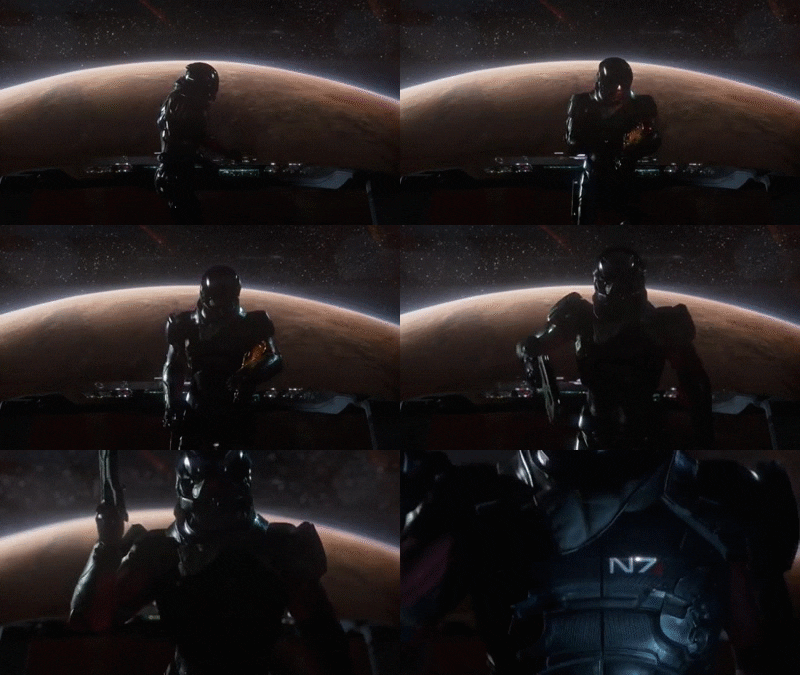
I spent hours in-game searching for great quotes from Shepard a few years back, when I got my Mass Effect tattoo.  I'm covered in quotes from books, movies, philosophers, etc, and I thought Shepard might have something profound to add to this.  Nope.  I ended up with an N7 tattoo I adore, and that fits the spirit of the series, far better than "I should go" ever could.

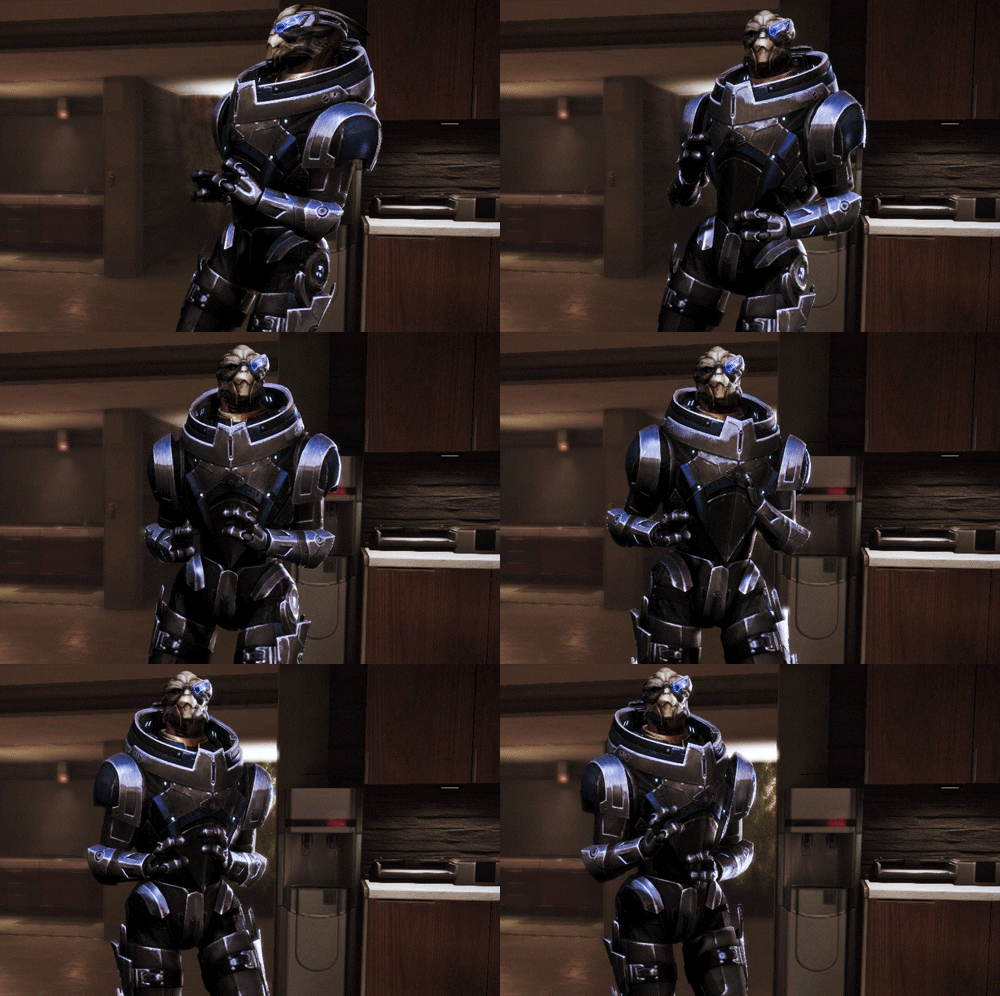
Nor, frankly, was the animation ever that amazing.  One walk into the battery to talk to Garrus, only to have him turn his head around Exorcist-style just to say "Can it wait for a bit? I'm in the middle of the calibrations?" was enough to know that.

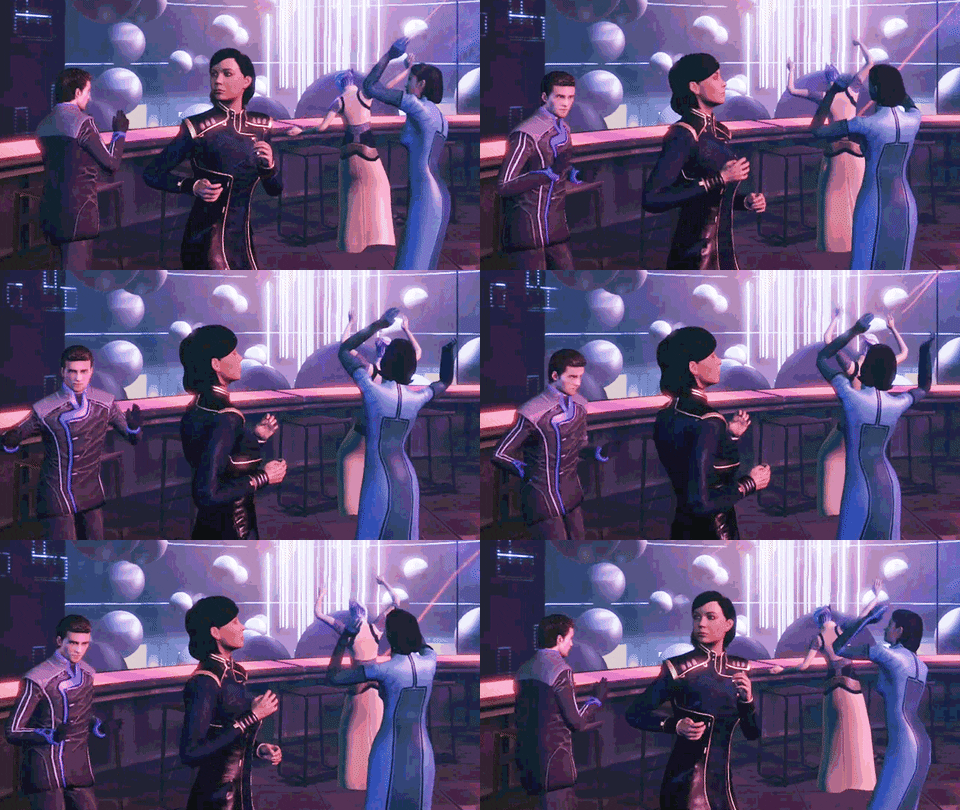
Don't believe me? Just watch Shepard dance:


So I'm not passing judgment based on some animation issues.  I want the GAME, not some critic's issues with it.

Nor have I maxed out my 10 hours on multiplayer, but I'm getting close.  And that... whew.  That might be worth the money in and of itself -- it's awe-inspiring. It's fast-paced and brutal, full of challenges and new enemies, and some stunning new combat effects that frankly, I am having a ton of fun playing.  Every time I jet-pack over some destructive enemy, only to drop a biotic punch on them that reverberates through the field, I absolutely adore it.

I've seen criticism here too, and again, I'm not sure what people were truly expecting.  It's often the same set-up as the ME3 multiplayer: cooperative teams fighting waves of enemies, each wave tougher than the last.  There are a mix of hacking, disruption, and survival goals, and as before, having a mix of races and classes offers you the best chance for success.

Bioware has also eliminated the part that made ME3's multiplayer so irritating: It is no longer mandatory, and instead a way to earn additional points, tech, and rewards should you be so inclined.

Then again, I don't play FPS online games like CoD or Battlefield or anything else.  FPSs make me motion sick, so there's that, but I also don't like the attitude of noobs vs. people with too much time on their hands vs. casual gamers; I prefer the cooperative aspect in ME where I don't have to be the best to enjoy myself.  This gives me the chance to play with others, to explore incredible combat styles, and still have fun.  To me, that's the best of all worlds.

Sure, there are opportunities for microtransactions, and the multiplayer menus aren't the easiest to navigate, and of course, playing the maps without knowing anything about the enemies you're fighting from in-game experience makes things difficult.  But no game, no matter the time investment  of the developers or its fans, is without flaws.  I don't expect it to be.


It helps that it's fabulously fun to play.  When I can do THIS...


... and take some enemy out, I don't really care if there are micro-transactions or difficulties muting other players.  I just wanna crush a bitch and get up for the next wave.

Get ready: Only 3 days until we hit Andromeda.


Monday, February 13, 2017

The Evolution of Jurassic World, part 2

Let’s face it: Neither of the two movies between Jurassic Park and Jurassic World are particularly good. 

They’re marginally entertaining, sure – I own them all and it is with slight shame that I admit that I’ve seen each one at least a dozen times. But they aren’t good – they aren’t well written, they aren’t very well acted, and really, the plots are just a little too ridiculous to lend themselves to good filmmaking. 

That’s all what I’ve come to expect from sequels in general, so I guess in that respect they’re about on par with other movies. 

The bigger issue is this: Neither The Lost World nor Jurassic Park III have the ethical questions built into them that Jurassic Park does; they in fact barely even touch on them.  They aren’t as frightening or intrinsically precarious, nor are they as profound.  

Jurassic World, however, is a step back toward the 1993 original. 


I will note now: I’m going to try not to spoil anything in general, and I guarantee I will not spoil the big twists of the movie.  I can’t guarantee no spoilers overall simply because I’m not sure what everyone would consider a spoiler, but also because it’s been over a year since Jurassic World hit theatres.  After that long, spoilers don’t count anymore J

First let me say this: there’s no question that Jurassic World is a successful movie.  It made a disgusting amount of money -- according to boxofficemojo.com, more than $1.6 billion dollars worldwide.  And while it has a 72% on Rotten Tomatoes from critics, viewers gave it nearly 80%.  That’s not amazing like Mad Max, but it ain’t bad either.  If anything, the numbers indicate a stunning draw for the general public around the world. 

Maybe it’s not the best movie ever, but the highest-earning, most fun movies are never Oscar winners. 

Fun is a big thing for Jurassic World.  It’s reasonably well-written, lots of good one-liners even if the characters aren’t exactly dynamic. And even though you can predict the plot twists a mile coming, they’re still entertaining and fun to watch. 

Bryce Dallas Howard isn’t great on her own, as most of us who have seen The Village were already aware, but she sets up some of the best lines in the film.  The symbolic value of her hair, straight and perfect at the beginning and curling gradually as she accepts that she’s no longer in control of the park, gives a visual representation of the themes the movie is trying to deal with, which I personally find hilarious.    

And Chris Pratt, a much stronger actor than I gave him credit for, really carries the movie.  As I watched, I developed an appreciation for him as an actual ACTOR that I never had before (though I can’t discount his comedic abilities on Parks and Recreation nor his abs in Guardians of the Galaxy).  He gives Owen Grady just the right blend of seriousness and sardonic wit, so even when he delivers that last super-cheesy line about staying together for survival, you can’t help but smile along. 

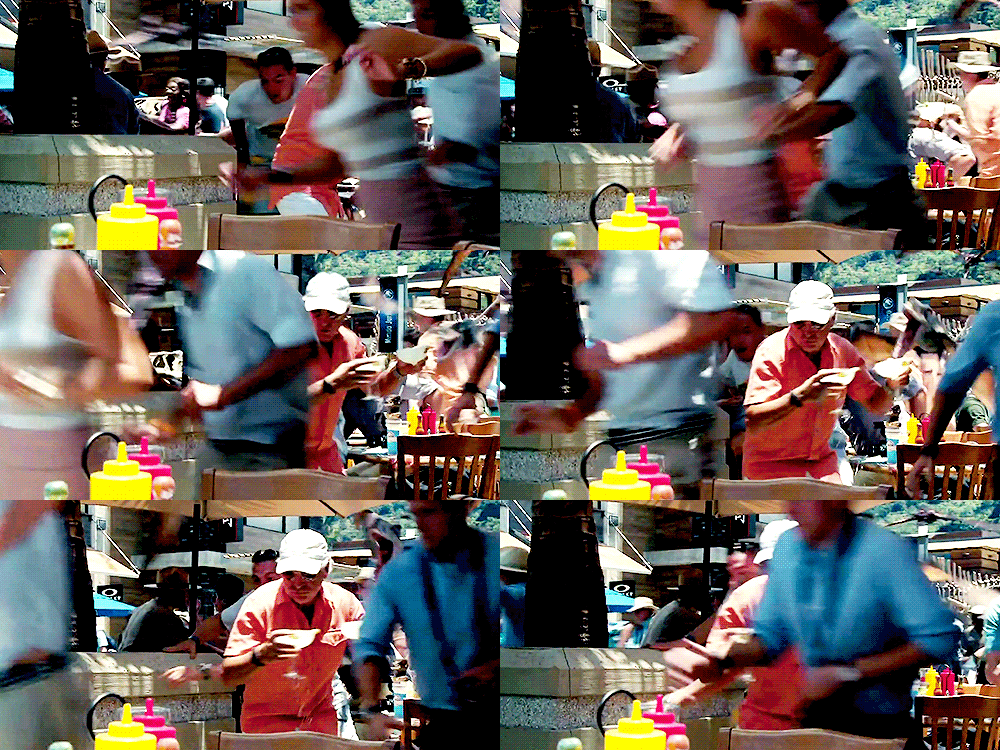
My husband and I quote Pratt’s “I was in the Navy, not that Navajo!” line now whenever we’re trying to find something, and the clip below remains one of my favorite Easter egg moments in film:


There is plenty here to pay homage to the films that came before it, most especially the original, and that awareness of its origins showcases the writers’ abilities as well as sets it up as a sequel instead of a complete remake. 

Really, the biggest problem with Jurassic World lies in its theme. 

The movie is littered with hints of depth – Chris Pratt and Bryce Dallas Howard are constantly bickering about control, a throwback to the ethical dilemmas of the first movie, and the dinosaurs’ genders are constantly mixed up, hinting at the male normativity that infiltrates American society.  But Jurassic World never delivers on that depth, and that’s what truly sets it as a worse film than the original. 

The recurring quips and side remarks about control, for example, are strong allusions to the conversations about control from the first movie.  But when they aren’t followed up by that conversation itself, they lose some of their power.  Plus, since most of those quips take place between Howard and Pratt, who are also batting around a low-simmering if obligatory sexual tension, that conversation about control becomes a commentary about male and female dynamics; that’s infinitely less deep considering that basically all romantic comedies have that exact same commentary. 

And yes, the InGen guys are constantly messing up the sex of the raptors.  Everyone else – everyone who respects the raptors, no surprise – keeps correcting them too, and that’s all great for starting a dialogue on how masculine normativity is inherent and problematic.  Except that dialogue never happens, and instead everyone who calls the raptors male instead of female just gets eaten.  Not exactly subtle. 

Now: I realize that, in part 1 of this essay, I talked about how being eaten serves those who want to exploit the raptors perfectly.  That's pretty contradictory to what I said here about Jurassic World, but hear me out:  If that conversation about ethics is built into the movie, as it is in Jurassic Park, then it's fine to have the Rex eat them later.  But in Jurassic World, the bad guys getting eaten IS the conversation, and that's not nearly enough. 


There is, again, the start of the conversation about extinct animal rights, both as weaponry and as product placement.  The sponsorship of the Indomitus Rex by Verizon Wireless is only the beginning, as Lowery, the tech guy, notes to Claire early on.  And of course Hoskins wants to recreate military tech into animal support, which is an interesting if misguided thought, as Owen doesn’t hesitate to point out.  All of these discussions again reflect the original movie. 

In both Jurassic Park and Jurassic World, there is always someone to remind us that these dinosaurs are actually animals.  No matter how people – either us or those on-screen – choose to look at them, they will remain animals.  That includes their instincts and impulses, and no amount of training can “suppress 65 million years of gut instinct,” as Grant puts it.  Humans can’t control them, no matter how pretty the illusion might be. 

But while Jurassic Park spends tens of minutes -- an eternity in movie-time -- actually discussing this, long before the power goes out and chaos ensues, Jurassic World never quite gets there.  It will forever be below its original for that reason, and even if I understand that its writers weren’t trying to just remake the original, it’s still a drawback.

The CGI nature of this film fits right into this issue.  Where Jurassic Park used so many real-life models, thanks to Stan Winston, Jurassic World uses almost entirely CGI, and no matter how carefully integrated, CGI changes things.  When the T-Rex headbutts Lara Dern and she screams as she smashes sideways, when the glass roof on the car shatters as the Rex dives after the kids, those moments are real in ways that the Indomitus Rex biting the gyroscope in Jurassic World just can’t be. 

Despite all this, I loved this movie. 

It’s just so fun – and trying so hard to be deep that I have to give it some credit.  There are moments where I had to cringe at the lack of subtext, but there are also moments where I genuinely jumped or laughed.  It’s paced well, especially for a big-budget, 2-hour movie, and in fact I could have used about 10 more minutes of Pratt riding his motorcycle with the raptors. And the ending… sure, it’s predictable, but it’s fun, and if a movie handles something well, I just can’t argue that the mere predictability of it will ruin the fun.  :) It sure didn't here.


I've seen it probably six or seven times by now, and I’m sure it has many more viewings to come in my household.  Could it have used a little pause for the conversations its writers clearly wanted to start and did not follow through? Yes, definitely.  However, and more importantly: it does the first film justice, and I could not ask for a better continuation of a story that I have adored since the start.


Saturday, June 25, 2016

The Evolution of Jurassic World, Part 1

I often forget that the 1993 original Jurassic Park is a horror movie.

Every other Jurassic Park movie, including the latest installment Jurassic World, has lost that title.  Instead, they are action movies – not that there’s anything wrong with this, of course.  But it makes them different, and in doing so, the original stand out. 

When I hear the quiet thud of the T-Rex moving through its paddock, I still get that heart-thump of adrenaline, even after countless viewings.  That first roar as she steps between the cars still makes me cringe, and I still watch Ellie’s trip through the jungle as they out-run the raptors through clenched fingers.  And that scene in the kitchen, where the raptors hunt the two kids, still gives me chills – even now, at 27, I watch it curled with my feet on the couch and a blanket over my head like I did when I was seven years old and experiencing it for the first time. 

I love Jurassic Park.  And now, since Netflix recently put all three of the original movies up, I’ve been re-watching all of them, with the addition of Jurassic World of course.  In doing do, I’m struck even more by the original – as terrifying as it is, Jurassic Park is also a deep, complicated movie about the ethics of genetic engineering and humanity’s control over nature. 


Part of what’s so terrifying about Jurassic Park is the illusion of control over nature.  This is a fairly straightforward concept to start: Humans can’t control nature. The end.  We can’t control the weather – as evidenced by the ongoing wildfires in California.  We can’t control animals – as evidenced by so many species that are slowly going extinct around us. And we can’t control so much more about our planet, about ourselves.

Something about that lack of control fundamentally bothers us, and so Jurassic Park, with its careful genetic manipulation and park control and monitoring systems, tries to address that.  Things inevitably go wrong, of course, otherwise we wouldn’t have a movie.  But the way things spiral out of control offers commentary on that lack of control and the acceptance it requires in order to live peacefully. 

Control offers humanity a variety of benefits.  Safety, stability, no surprises, and more – think about the basics of the American dream.  Those boil down to being able to control your life.  There is nothing wrong with that. 

But control has a dark side.  

Consider this:  A 2015 article in Women’s Health magazine discusses new advancements in genetic manipulation and in vitro fertilization.   Part of this includes screening for genetic disorders; if a parent is a carrier, doctors can now ensure that embryos do not carry those genetic markers, thus ensuring that a potential child will not have that disorder. 

Thus, a national conversation about genetic engineering is booting up as the possibilities of science catch up with the fiction of movies and imagination.  Questions of control lie at the heart of this issue: Can we control the genetics of humans in an effective, non-dangerous way?  And where does control intersect with ethics?  After all, using genetic engineering to eradicate a disease is a different goal than using it to control eye color or sex.  So where’s the line?

To me, an essential element of the line you shouldn’t cross lies in proceeding without ethics to guide you. 

It’s a slippery slope, this ability of genetic engineering, and I’m not trying to channel Ian Malcolm when I say that.  Fixing a genetic disorder makes sense; fixing it only for those who can pay through the nose is questionable.  Allowing parents to ensure their baby will be born healthy makes sense; allowing them to engineer the ‘perfect child’ is questionable. 

But people will disagree with me.  What I see as questionable others may find perfectly acceptable, and that’s part of the problem.  There is no black and white answer to the subject of ethics – it’s easy to say, “Yes, I’m an ethical person” and much harder to live your life that way, just as it’s easy to say you won’t judge and much, much harder to actually follow through. 

These questions of ethics instead revolve around, not personal ethics, but the ethics of science, the ethics of what lies in possibility tempered with what’s actually a good decision.  Instead of what I personally agree with, it’s more about thinking about the possibilities, acknowledging the potential downfalls and ways things could backfire, and thinking deeply about the implications and consequences, all long before the action is ever taken. 

That gives the world a much better chance of an ethical decision, even though there are no guarantees.  Nuclear power and nuclear war come from the same fundamental ideas, after all, and they are very different things.

In Jurassic Park, it’s made clear that some of those elements have been considered, but as so many are quick to point out, it’s hard to consider the negatives when considering them might advise you to turn back.  Ian Malcolm even says it: 


The conversation about “can” versus “should” is becoming more prevalent in our society every day, and I’m not always sure I like what I see. 

Think about the genetic engineering of crops.  It is certainly possible that engineering crops like corn, soybeans, and many others could solve the hunger issues of our planet.  If we can make plants resistant to droughts, or to certain pests, or anything else, we can change the face of agriculture around the world. 

Notice the “can” here. 

But when it comes to the question of “Should we do this,” no one has a good answer.  Sometimes crops don’t work well and cause physical problems like diarrhea in humans.  Sometimes the people who engineered them don’t handle things well, like Monsanto’s questionable history of lawsuits involving small-time farmers and their products.  Sometimes we just aren’t sure what might happen, 50 or 100 years from now, and since we can’t predict the long-term consequences, maybe we should hang back until we can. 

We live in a world with the ideal vision of control – but as Ellie Satler reminds us, “You never had control, that’s the illusion.”  The creators of Jurassic Park think they have control – they control chromosomes, DNA, and as Wu brags in one moment, “It’s really not that difficult.”  But since its very existence is predicated on genetic engineering, the question of should is everywhere. 

That's what makes Jurassic Park such a continually relevant movie -- why it continues to hang on, continues to be popular despite the fact that it's over 20 years old.  In Jurassic Park, the questions we struggle to deal with in the real world are deceptively simple: Don’t cross the line.  Or get eaten if you do. 

All those characters who object to the genetic engineering of the dinosaurs, survive.  Those characters who endorse it, even capitalize on it (like the lawyer, Gennaro), are killed.  Even Hammond – I realize he doesn’t die in the first movie, but he definitely dies in the book!

We watch this horror movie, and we can sit back and think, "Wow.  If only we could solve things so easily here."  Perhaps not with the same strategies, of course, but having a T-Rex eat those on the side of what's ethically wrong would certainly simplify some of our own ethical dilemmas.  


It's not that simple here, and we know it.  Despite how politicians might shout about who is right or wrong, American society struggles to articulate what's ethical and what's not.  We struggle to understand how and why and what we should do with the minimal control we have over our world.  And all along, we talk about the line: Don’t cross the line, don’t flirt with the line, don’t even think about the line -- but when we aren't sure what the line is, movies like Jurassic Park serve as a balm that lets us, just for a minute, fantasize that it could be that easy to solve.  

Tuesday, May 17, 2016

Crazy Fan Theories, Part 1: Game of Thrones, Season 6, Episode 4: "Book of the Stranger"

So remember when I wrote this post, about how I was really not into Game of Thrones Season 1?  I was waltzing along, bored out of my skull at the endless talking and limp wangs of the show, while you seasoned veterans were likely going, "Oh, Equinox, you sad, sad fool."

Well, to everyone's relief, that's changed since then.

I did indeed make it past episode 6 of GoT Season 1, and in fact I made it through most of Seasons 1, 2, 3, & 4 within only a month or so of each other.  I love this show.  I in fact worship this show like Robert Baratheon worshipped the ground Lyanna Stark walked on.

Too soon?

(This is about the time I point out
since I am 100% up to date on GoT... ) 

In the past few weeks, we’ve seen Bran’s storyline finally get interesting.  I mean seriously – episodes on end of him being “OMG I can warg into Hodor!” and he’s not even doing it to get laid? Boring. 

At the end of season 4, when he finally reached the cave with the 3-eyed raven, some serious shit went down: the battle with the wights, Jojen’s death, and the super-creepy girl who is one of the Children, the original inhabitants of Westeros.  All of a sudden, Bran’s story was fascinating. 

Then he vanished for the entirety of Season 5.  Wtf, guys??


But now that he’s back, his storyline is kind of my favorite.  I mean, watching Tyrion manipulate basically everyone into doing whatever he wants is always entertaining, and the scene where he makes awkward small talk with Grey Worm and Missandei is one of the most painfully brilliant conversations out there.  And of course there’s Jon Snow’s resurrection, which Kit Harington himself ruined for me –


But I can forgive him since it means Jon Snow LIVES.

So other than them, watching Bran scramble around in the past is my favorite.  I’ve always liked flashbacks for their power to show what’s only ever been hinted at, and boy, did that play out in Season 6, Episode 4: Book of the Stranger.     

Bran heads back years, to the moment when Ned Stark defeats Sir Arthur Dayne to rescue his sister, Lyanna, from the tower where Prince Rhaegar has been keeping her prisoner.  The scene ends before Ned, who looks like he’s about 20-25, enters the tower, thus preventing Bran from seeing what he found inside.  The 3-eyed raven says that “that’s enough” for now, but it’s clear that Bran has some suspicions about what Ned found. 

And I do too. 

Rhaegar Targaryen is the son of the Mad King.  In kidnapping Lyanna Stark, we can only assume that he likely raped and tortured her before her death.  We have no idea how she died – though perhaps Bran will find out eventually – only that she’s dead, and her kidnapping inspired Robert Baratheon’s War of the Usurper, the event that ultimately set off everything else currently happening in Westeros.

Here’s the thing: We know Lyanna Stark died in her brother Ned’s arms. What if this tower is where that happened? And what if, assuming Rhaegar did indeed rape her, she was pregnant?  Let’s go further and assume that her baby survived, even if she did not – she could have died in childbirth, or Ned could have found her near death and saved her baby, we don’t know. 

Right now, Daenerys Targaryen is the rightful heir to the Iron Throne as the only surviving child of Aerys II, the Mad King.  But according to most inheritance laws, that right passes through firstborn blood rights; if Prince Rhaegar was the heir, his eldest child would be the next heir, and so on through his bloodline.  His younger siblings are only in line for the throne if his children die.  Now, all Rhaegar’s children by his wife Elia Martell were slaughtered by Sir Gregor Clegane, the Mountain, during the Sack of King’s Landing by the Lannister army at the end of Robert’s Rebellion.   Thus, Rhaeger’s line ended, and his younger siblings by rights inherit the throne, even if Baratheon did usurp it somewhat successfully. 

BUT: if Lyanna Stark had a baby, it would likely be the child of Rhaegar Targaryen, meaning that child would replace Daenerys as the Targaryen heir. 

Jon Snow, former Lord Commander of the Night’s Watch and assumed bastard of Ned Stark, is the rightful heir to the Iron Throne.


I realize this is not exactly a new theory.  However, a lot of what I’ve read is circumstantial: Jon Snow walking into the room as Aemon Targaryen says something about his family being alone in the world, the mirroring of public executions and rises to power between Snow and Dany, Melisandre only trying to seduce men who have a claim to the throne.  Those are all lovely little breadcrumbs dropped throughout the show, but they are also easily explained away as coincidence. 

One clue is not, and that’s where I want to start: the comment Stannis Baratheon makes about Ned Stark not being the kind of guy to cheat on his wife.


Ned Stark, for all intents and purposes, has never been anything but loyal to his wife Catelyn, other than one tiny indiscretion that produced his bastard son Jon Snow.  He brought this baby home from the war and asked his wife to raise him without any comment about his mother.  Catelyn has always been conflicted about Jon Snow – she trusts her husband, but Jon is also only slightly younger that Robb Stark, meaning Ned would have had to cheat on her basically at the same time as they conceived his firstborn son.  The timelines are a little too close to make sense that he conceived a child with someone else while away at war. 

Then, of course, there’s the conversation by the river.  First, Robert Baratheon asks Ned who Snow’s mother actually is, and Ned, in no position to refuse, tells him her name was Wylla.  If you’ve read the books, you probably know that Wylla is of rather undetermined status: she was a maid and a wet nurse for House Dayne, but we don’t know if she’s still alive nor is there any evidence that she and Ned actually knew each other. 

[Another possibility is Ashara Dayne, who killed herself over the death of her brother at Ned’s hands.  I don’t put much stock in this theory, even though Catelyn Stark was commanded never to mention her name by Ned himself at one point. Personally, I think this is all Ned just trying to keep Jon’s existence on the downlow, because if the Great Houses of Westeros figured out his true parentage, he is in grave danger.] 

Don’t forget when Ned Stark pulls Jon Snow aside to talk about his mother. That conversation never happens – Ned starts it, but they are interrupted, and then separated, and then Ned is beheaded by Joffrey Baratheon for treason before they are ever reunited.  The secret of Jon Snow’s mother dies with him, presumably. 

This is already super suspicious, and we aren’t even out of Season 1 (and book 1). 

#varysuspicious
Then I’m going to skip ahead – my knowledge of Season 2-4 is a little shaky since I haven’t seen them in over a year, and I read the books in 2011.  But considering that all the really important stuff to support my theory shows up in Seasons 5 & 6, I’m okay with it.  Maybe I’ll re-watch them and expand this until it’s long and obnoxious and completely irrefutable. 

So at the end of Season 5, Jon Snow is murdered. 

This caused basically everyone who’ve been rooting for him to throw up their hands in disgust and claim that they are never watching Game of Thrones again. 

They are all lying. 

Season 6 starts with Snow’s body, cold and bloody, being dragged inside Castle Black by his supporters.  Davos and Melisandre conspire to attempt to bring him back to life, though Melisandre needs some serious convincing.  Her entire life, her entire religion, have been based on what she sees in the flames, and with Stannis’ and Jon Snow’s deaths, everything she thought was true has been lost. 

After all, she saw Jon Snow alive and fighting at the coming Battle of Winterfell, and how can that be possible if he’s dead? 

But with some convincing, she performs a rite to bring Jon Snow back (including cutting his hair so it’s the right length for Kit Harington, who cut his hair immediately after Snow was stabbed to further the illusion that he was, in fact, dead.  Since everyone knows Harington’s hair is under contract (check out this video if you don't believe me) with HBO, everyone lost their shit – if his hair was gone, then so was Jon Snow.  Clever.) 

Anyway, it works – Episode 2 ends with Jon Snow’s dramatic revival, and Episode 3 opens with him waking up to finger his own stab wounds and wonder what the fuck happened, exactly.  Melisandre asks him what he saw, reacting poorly when Jon tells her that “it was only darkness” before Davos ushers her out. 

The fact that Jon Snow lives is not, in and of itself, proof that he is the son of Rhaegar Targaryen.  

But it is promising. 

Who knows? Maybe he is just as surprised as we are. 
Think further: The books constantly reference just how much Jon Snow looks like Ned, which would seem to be evidence in favor of Ned’s adultery as opposed to a child of a Targaryen.  Their House is known for their long silvery hair, achieved by intermarrying their siblings and something Jon obviously lacks.  But think carefully: That doesn’t mean Ned’s his father.  We already watched Ned follow dark hair as a dominant gene in Season 1 in order to determine Joffrey’s true parentage, so we can extrapolate that if Rhaegar Targaryen fathered a child on someone with dark hair, her genes would win out.

And Lyanna is a Stark, after all.  All the Starks have dark hair except Sansa, who clearly resembles her mother Catelyn.  Otherwise, it’s nothing but dark hair as far as the eye can see. She and Ned are both children of Rickard Stark; perhaps Jon looks like his grandfather and no one quite realizes it. 
Except Ned, of course. 

Ned’s constant visits to his sister’s grave (as evidenced by Sansa’s memories throughout the show) also support that Jon Snow is his nephew, as he would want to honor Lyanna’s memory by raising her son well.  And as tension in Westeros rose, he would also want a reminder of who he was protecting, and why, in keeping Jon’s parentage a secret.  He does mention to Jon that they may not share a name, but they share blood.  He’s not lying; he’s just not telling the whole truth either. 

That’s a massive pile of Stark-related evidence that Jon Snow is in fact the child of Lyanna and Rhaegar Targaryen, and by extension the heir to the throne. 

What about everything else?


The clues here lie in the words of House Targaryen: “Fire and Blood.” 

Daenerys Targaryen has built her reputation on being The Unburnt, including her dramatic emergence from the Temple of the Dosh Kahleen at the end of Episode 4.  This suggests, at least on some level, that she’s immune to fire.  If you can’t buy into that, then hopefully we can at least concede that she has a unique relationship with fire.
 
There’s no evidence that Dany follows the Lord of Light, but I have no doubt she’d approve of his fire-based message.  She repeatedly uses fire to serve her own purposes: as a way to cleanse herself, as seen in her rebirth as the mother of dragons, or to dispose of her enemies, as seen in her destruction of the misogynistic leaders of the Dothraki, allowing her to (presumably) seize power next episode.

Back in Westeros, Melisandre, a Red Priestess, receives her visions (as well as her power to defy age) from the flames.  She’s also pulled prominent leaders into the Lord of Light’s influence, most obviously Stannis Baratheon and his wife.  Baratheon adopted the flames into his house sigil, his wife so devout she watched gleefully as her brother, a sinner, was immolated for his adherence to the old faith.  Flame is cleansing, used to preserve the faithful and destroy everyone else.  In addition, flame is how the Lord of Light accepts sacrifice in return for his favor, most notably Shireen Baratheon in Season 5. 

The Lord of Light has power in Westeros, the power of fire and the power of blood. 

And who did the fire god choose to bring back to life?

Jon Snow. 

Blood should have killed him, and fire brought him back. 

The only remaining piece is for him to dramatically survive a fire that should have killed him (which I predict to be how his heritage is finally revealed). 

All hail Jon Snow, the First of his Name, Former Lord Commander of the Night’s Watch and the Prince that was Promised, the rightful heir to the Iron Throne, and future King of the Seven Kingdoms. 


Friday, April 1, 2016

April Fool's Day

I'm back!

Just kidding,  but it won't be much longer.

In the meantime, enjoy this April Fool's clip from my favorite video game creator!


Sunday, February 14, 2016

Fanfiction Confliction, Part 2

About six months ago, I gave in.

I'd been fighting it for months, trying hard not to be one of those people.  I gave it my best effort, I really did.

But I was powerless to resist.

I started writing fanfiction.

It started small -- I'm a writer by nature (I bet you couldn't tell! #sarcasm), and I spent most of early 2015 world-building in preparation for a bigger project.  When I started writing fiction for the first time soon after, I realized something: I needed practice.

I hadn't written fiction in probably 6 or 7 years, and while I had lots of nonfiction writing experience, the skills just aren't the same.

This was probably in July.

I started small: a short story, only about 2,000 words, that was a character study of my forever favorite DAI Commander.  That turned out well, if a little serious, so I took on some humor via Alistair in DAO.   And before long, I found that I was enjoying myself immensely in creating these new scenes, new moments, within my characters' lives.

I spent the first 10K words or so laboring under the illusion that I was just practicing styles for my bigger fiction writing projects, telling myself that as soon as I finished the next story, I was putting fanfiction away and moving on with my own work.

That didn't happen.  Instead suddenly I found myself so immersed in Bioware's Dragon Age sandbox that I couldn't get back out -- and I didn't want to.  I loved my Inquisitor, and I loved the story I was creating inside DAI:  the relationships I was growing, the conflicts I'd created, and exploring the themes of the game and its story in such depth and detail.

So now, when I'm writing this, I'm finally accepting that I'm a fanfiction writer.  It took a long time, and many thousands of words before I was willing to add that to my list of accomplishments on this particular blog -- about two weeks ago, I officially broke 100K words, and this is the first mention I've made of my fanfic hobby to anyone other than my husband.

But I'm ready.

(That's not totally true; I'm still a little hesitant.  But honestly, that's not because I'm ashamed of my work, but because my mom reads this blog sometimes and frankly, several of my stories are quite Not Safe for Work.  At all.  Like, explicitly NSFW.  Adult content ahead.  You've been warned.

Mom, if you're reading this, please skip all the ones rated "E" :-/

Anyway.)

Below, you'll find a link to my work, all of which is posted through Archive of Our Own.  I know there are other, bigger, fanfic sites out there, but AO3 is my favorite, and I'm proud to be part of their community.

Without further ado, and in the spirit of celebrating International Fanworks Day today, I give you: Once More to the Breach, my Shakespeare-allusion-titled series about Dragon Age: Inquisition.
Please enjoy, and thanks for reading!!


Thursday, November 12, 2015

N7 Day

It's weird to be a Mass Effect fangirl and share my birthday with N7 Day.

I never even knew there WAS an N7 day until after I got my Mass Effect tattoo -- which of course features the N7 logo straight from my femShep's gear.  When I had it done and people questioned the wisdom of getting a video game tattoo, I just sort of shrugged and went, "Oh, if someday I hate the game, then the tat will just be for my birthday!"

It never occurred to me that Bioware had already appropriated that day for its own purposes.


Then November 2014 rolled around, and the Internet (or, at least the pages I was frequenting), blew up with N7 ads for merch, Gaming Heads statues, and so on.

I felt so lucky.  Now, I have yet another reason to love on Mass Effect.  I had lots -- I follow both Bioware and Mass Effect (and Dragon Age, as if anyone's surprised) on social media, for goodness' sake -- but now I had another! The sales! The promotions! The outpouring of love for my favorite game series!

Of course, I get weird looks when I'm more excited for N7 Day than I am for November 7th, my birthday, but I don't care.


I'm not one of those people who loves their birthday.  Sure, they were a blast when I was a kid, but once I started to grow up, I just didn't have that kind of life that fosters an obsession with the anniversary of the day I was born.  I've never cared that much -- I've spent too many birthdays stressed out over schedules of how many hours I'm spending with each parent so my time is divided equally, per the divorce 'rules,' to get overly excited.  Nor have I, as a blossoming adult, ever found good reason to get too excited when history says that I'm going to be tired, pressured into hanging out with people I don't want to see, and receiving domestic-style gifts (like the memorable instance when, on my 21st birthday, my mom gave me a brownie pan and a recipe book.  Fun.).

Bishop knows all this, and thankfully he's a strong advocate for the "do whatever the fuck you want for your birthday" school of thought.  If I'm stressing out, he cancels plans with my family.  If I'm up for it, he tags along to every single event.  I think that in part, he agreed to getting married in early November just to give me something more exciting to celebrate than my birthday.

If only we'd known that all he had to do was introduce me to Shepard and her story, and I'd have been all over November 7th.


Of course, now that I've discovered Mass Effect, Bishop has taken that love to heart on N7 day, and he spoils me rotten -- mostly by handing over his "Equinox's Birthday Present Budget" to me and letting me go nuts on the Bioware Store's enormous Mass Effect-themed sale.

Come N7 Day 2016, I'll be decked out in ME shit and fit to party with the most hardcore of fans.

I love this day -- there are times when I feel isolated as a ME fan because too many of my fellow nerd friends hate ME3 and have thus abandoned the series.  I've been teased for my Spectre t-shirt in Kaiden Alenko blue and yellow, and despite how cool my to-scale Gaming Heads statue of Garrus is, non-nerds still give me funny looks and eye rolls over how much I was willing to spend to house a model of my favorite turian.

They'll laugh even harder when Tali arrives, I'm sure.

N7 Day gives me the chance to embrace my love of Mass Effect with fans all around the world, and I love it.  I can't wait for the saga to continue next year -- to Andromeda and beyond.