On my second to last day of school, my department took me out to lunch to celebrate.
It was what you'd expect -- lots of hugs and toasts and congratulations as I change careers. There were conversations about where I'm going, and why I decided to leave, and not a few people mentioned they'd never once thought I was unhappy. One colleague called me a lifer, like teaching is a prison sentence.
That right there tells you a lot about my mindset.
When someone inevitably asked what I'm going to miss about teaching, it took me embarrassingly long to answer. Eventually though, after kicking around about a dozen things I won't miss, I settled on the people.
It's the truth: I will miss my colleagues and friends at Herbert High. It's been a great place to learn and build a skill set, an awesome place to make friends, and for a lot of people, a place to spend their entire careers. Many of my colleagues in my department have been there for a decade or longer, and they are happy there. I will miss all that.
And this stands in stark contrast to my new job, where I will know no one.
That's the most important part, which I keep reminding myself: I have a job. It's not the job I thought I'd have, the one I've been writing about for months. That job vanished into a haze of office politics and fighting managers and never-ending budget cuts to the point where it's not even than they aren't hiring me; they aren't hiring anyone. What was a vacancy has become true downsizing.
In a lot of ways, losing that job isn't all that bad. Bishop and I know most of the people there, and suddenly they're all telling us that really, I don't want to be there right now. That the office politics that made hiring me into a point of contention between two managers are actually widespread conflict in the department. That there's no money for upgrading the tech, let alone hiring someone. That the manager on the floor is back to the age-old questioning of "What do we pay the IT people for?" when he should know better than anyone.
And, perhaps most surprising, that many of them are looking for jobs away from this one.
It adds up to mean that maybe I don't want that job anyway.
This info makes a lot of things better. But it also doesn't change some things, and when you struggle with anxiety, things like an easy transition and knowing who you'll eat lunch with the first day are important.
So when I say that I will miss my friends, I mean it.
I'm no longer walking into a new job knowing people. That was a huge part of the appeal -- I was going to know everyone! I'd know my boss, because he used to be Bishop's boss, because I've gone to baseball games and happy hours with him. I'd know my colleagues, because we've played D&D together, because we've gone bowling, because they've had LAN parties in my basement, because they're my friends.
It would have been the easiest transition ever -- I might be new to the field, but I knew the people.
Instead, that's not what's happening. I do have a job, and it's essentially the same thing: tech support. It pays better than the other job. It has the same or better benefits, perks, all that stuff. It's smaller, so I'll get more personalized support as I start learning more hands-on skills. I like it.
But it's not the same place I've spent the last year thinking I'd be working, so even if it turns out to be amazing, it will always be a little less. If the other place were to offer me a job in six months or a year, I'd jump at it without question.
I don't know these new people.
I know the possibilities though. When I walked into Herbert five years ago, I wasn't thinking about the future. I didn't consider that some of the conversations I had those first days were happening with people who would end up being some of my best friends. I walked into Herbert without knowing a soul, and was lucky enough to love it for a long time. That could very well happen here, again, and five years from now I could be in a place I never expected.
I just have to cross my fingers and hope for it.
A lot is changing that I am looking forward to.
I will never have to grade a paper again. I will never argue with parents about their kid's grades or effort or anything else. I will never have to sit in awkward meetings with principals while they attempt to get a 15yo to agree that putting "ISIS can suck my dick" on their in-class presentation is in fact inappropriate. I will never have pretend to care that a kid said shit (or worse) in my classroom. I will never have to attend a pep assembly or homecoming parade. I will never have to confiscate a phone, or a golf ball, or a fidget spinner.
I am sure that, instead, I will get a host of new annoyances, like any job. There will be paperwork that's frustrating or busywork, annoying coworkers, and since it's new, I have to believe I'll be forced to play at least one mind-numbing 'icebreaker' game.
That's all okay. In exchange, I get to do a lot of things that are new and exciting, and it won't take long before the frustrations of my old job start to fade.
At my new job, I'll never have to confiscate a phone or computer again. Instead, I get to actually work with them -- solve problems, help others fix things, figure out new ways of going about issues. I'll get to do all the background stuff no one thinks about, like digging through the Control Panel for the right settings, or migrating data, or editing the Registry to make things easier. I will get to enjoy technology instead of police it.
And I will never have to deal with teenagers again. Sometimes teenagers are great -- they'll open your eyes to new ideas and viewpoints, they come in excited to share events and stories, they'll hug you goodbye and mean it on the last day of school. But most of the time, even the best of them are frustrating -- they don't want to do homework, they're quiet during in-class discussions, they openly admit that they don't start their papers until the night before they're due. I won't miss any of those things, even if I might occasionally miss the kids themselves.
I won't travel, which was a part of the other job I was conflicted about. I like to travel, but I was never sure about traveling one out of every three weeks -- that's a lot of time on the road, a lot of time to sleep in a hotel and eat at crappy restaurants and miss Bishop. The trade, that I have a job where I'll travel at most twice a year, is actually quite nice.
And sure, I have to get an iPhone, which to a devout Android user is like voluntarily contracting the plague. But it's a phone coming from my company, not my personal phone, and more than anything, it's an opportunity to grow and keep learning.
Really, all of this transition, this mess of uncertainty where I have a job but another might call me in a week or a month or a year, is just an opportunity to learn. That's what I keep coming back to: No matter how this plays out, no matter if the boss I know at the other jobs puts me in an awkward position in a month, no matter if this new job is where I stay for years, this is an incredible opportunity to change my life.
That is never bad.
Sunday, June 18, 2017

Sunday, May 28, 2017
A Grand Theft Auto Proposal
I was sitting in a faculty meeting about three months ago,
stuck at a table full of teachers I didn’t know very well. This wasn’t all that surprising; our
administration had decided to do some kind of team-building exercise that
morning, meaning we didn’t get to choose our own groups. God forbid we be comfortable.
So I was sitting there, making faces at my friends at
another table because some things don’t change no matter how old you are, when
I realized that the discussion at my table was getting heated. I tuned back in, only to discover that
they’re talking about the latest pep assembly theme.
Well. Talking is such
a weak word. Complaining is really more
accurate, since the theme the students had chosen that year was Grand Pep Auto,
reminiscent (and nearly copyright infringing) on the game.
Everyone around me was pissed. They were bitching about the same issues with
the game that I’ve heard a million times before: that it advocates cop-killing,
violence against women, committing crimes for prestige, and a million other
things. One teacher’s husband is a cop,
and so she said she couldn’t with a clear conscience stay silent about the
issue.
Within days, it would go to my building principal, and
within days, it would get changed to something more innocuous. More sanitized. More acceptable.
And still none of them understood why I was chuckling as I
listened to their argument.
Grand Theft Auto is the Modest Proposal of our day, and yet
no one seems to notice. It’s as if I
suggested we replace school lunches with babies, and instead of laughing,
everyone started screaming.
I just don’t get how no one else has figured it out.
Don’t get me wrong: I 100% realize that GTA = satire is not
exactly a new thesis. But having taught
A Modest Proposal, and having witnessed countless discussions like the one
above, I still cannot help but be surprised.
 |
| I did not create this image, but fuck, it's funny. |
First: A Modest Proposal. For years, I taught this pamphlet as part of Senior Literature, and every year, I passed it out and asked students to read it without any kind of preamble or explanation. This goes against a lot of teaching wisdom – I should be giving them background information, connecting it to other stories we’ve read, making it relevant to them. And I do, once we read.
Doing all that BEFORE they read takes away all the fun.
For some context (just in case you aren’t familiar with this
text): Jonathan Swift wrote A Modest Proposal in the early 1700s as a reaction
to the poverty crisis of the Irish under British rule. In it, he suggested that the Irish should,
quite simply, birth and raise and finally sell their children to the wealthy
upper class in order to make money and work themselves out of poverty.
The wealthy upper class would then eat the children as a
tender, succulent supper. Yum!
As you can imagine (I hope), this idea did not go over well.
Now, close to 300 years later, this overreaction is still
the result I get from my students, and it’s hilarious. They don’t realize it’s satire, at least not
the majority of them. Here and there, I
get students who looked it up before they came to class, or students who walk
in going, “Ms. E, he’s not serious, is he…?”
But far, far too many walk in asking why I made them read such an awful
story, complaining about what a terrible human being Swift is, and
(occasionally) wondering aloud what their parents would think if they told them
what I had them read.
Always, always, always hilarious.
By the time the day’s lesson is over, most of them are
persuaded. It’s satire. Swift doesn’t
really want us to eat babies. They
didn’t miss some important part of Irish/British history in their studies. No worries.
But there are always exceptions. No matter how much we talk about fairy tale
satire like Shrek, and sarcasm in writing like Dave Barry, Augusten Burroughs,
David Sedaris, etc., some students still walk out going, “What a messed up
story.” It won’t click – they aren’t
abstract enough thinkers for this to work, and no matter what I do, some of them
will stay that way.
They then, in turn, grow up to become the teachers and
parents and everyone else who doesn’t get what’s going on with Grand Theft
Auto.

This is really a shame, because what Rockstar Gaming has
done with the GTA franchise is kind of amazing.
But there is so much more depth to this satire that just
that we Americans are a bunch of over-caffeinated, sex-obsessed assholes. (It’s terrifying to think that’s how people
the world over think of us, isn’t it? *shudder*)
Think about the biggest complaints about GTA. Cop killing.
Prostitute killing. No
consequences for committing crimes. All those things that, apparently, parents
are terrified that little Johnny will start doing if they play this game, as if
the world is just one tiny push away from descending into total chaos.
Then again, we did put an oversized, racist Oompa
Loompa into the nation's highest office.
But the 2016 election aside, generally, America isn’t
entirely abandoned to the darkness just yet.
Parents, teachers, politicians, and many others, however,
disagree.
This is how GTA earned its terrifying reputation. I understand there are certainly
elements of GTA that are despicable, but to me that’s almost part of the
hilarity. Players can visit a
prostitute, at times complete with cut scenes, pay her, and then kill her and
take the money back. That’s awful on the
face of it, but the sheer absurdity of the exchange is hilarious. That’s one of the most obvious tenets of
satire – hyperbolic events in order to showcase their absurdity. So it’s fitting, even if I cringe.
But so much more of GTA is a commentary on what people are
able to do, and get away with, in our culture.
How many times have we as Americans seen men commit violence
against women, and get away with it? We
need only think back to last year to the Stanford rapist, a man whose crime was
absolutely heinous, and yet the judge was so concerned with the rapist’s future
that he only received 6 months in prison – and only served 3.
There is less difference between how players get to treat
women in GTA and how real life men are allowed to treat women than we like to
think. Fewer repercussions in the real
world than we want to think. Fewer
consequences. Less jail time. More like
GTA, really, and no one wants to say it.
People around the country called out the rapist himself, his
defensive father, the author of this article, the Washington Post itself. The case and how it was handled changed rape and sexual assault laws in California, strengthening the wave of ‘yes means
yes’ consent and sexual education rolling through college campuses across the
country. That's all positive, but it
doesn't change the statistics of on-campus rapes, for example, or the mindset
that if I'm wearing a short skirt, I'm asking for it.
How many times are cops attacked for how they respond to
crises, whether it’s with too much or too little force, too many or too few
officers, whatever the case might be?
GTA, by allowing players to beat up, shoot, set fire to,
what have you, the cops in the game are pointing out just how absurd it is that
cops really do get treated like this. It
may not be the norm, of course, but when it’s plastered across the news, it
certainly feels that way.
The issue of police violence inevitably leads into issues of
racial stereotyping, and here, GTA deals frankly with just how ridiculously
prejudiced our culture is.
How many times have young black men been stereotyped as part
of gangster culture? That they are
shitty human beings, simply for wearing a hoodie?
Trayvon Martin springs to mind, as does Michael Brown and an
unfortunately large number of others attacked or killed in recent years. Hoodies routinely get banned in schools for
the reputation they carry.
How we are still arguing that somehow GTA is the problem in the face of the rest of America is beyond me.

All these satirical takes on real American issues aside (as if we can just forget them that easily), critics often forget that the game itself is not advocating any of these crimes. There are in-game penalties for killing citizens at random, for shooting hookers, for running over cops. Hell, you attract the attention of the police by running red lights, something I know for a fact doesn’t always happen in the real world.
The game doesn’t want players to be assholes – it wants them to
follow the story, like all games. The
fact that they’ve built a world where the player can interact with 100% of
their surroundings is testament to how much time and effort the developers put
in, not that the game should be condemned.
 |
| one of my favorite satirical billboard in the game |
Let me also remind you: GTA is not a game for kids.
I feel like I shouldn’t have to say that, but all things
considered, I absolutely have to. My
eleven and eight year old nephews have played GTA, for god’s sake, and then
their mom complains that video games are too violent. No shit.
That’s an essay for another time though.
Whenever this comes up, Bishop inevitably tells me this story from
when he worked at Game Stop as a teenager:
A mom came into the store looking for a game for her young
son. Since this was the early 2000s,
Bishop recommended Pokemon, a fun and popular game rated perfectly for her
child, who was about 10. The mom, I shit
you not, said that she wouldn’t be buying Pokemon for her child because it was
Satanic (and if you don’t believe me, just Google it; there is a TON of discussion
out there about how some deeply religious people see those little Japanese
monsters as demons. Something about a
satirical interview no one understood -- no surprise!)
So, possible demonic connections aside, she didn’t want to
buy Pokemon for her kid. Fine. Did she instead go pick up Super Mario? Any
of the Harry Potter games? Hell, even Lego Star Wars?
Nope. She walked over
to the felony-titled Grand Theft Auto and, ignoring the giant M FOR MATURE
label, proclaimed it perfect.
Bishop also never fails to finish this tale with how pissed this
woman was when she tried to return it later, as if her poor parenting was
somehow Game Stop’s fault.
The warning labels are there for a reason, people.

Frankly, the whole notion of someone seeing the M rating,
shrugging, then being pissy that the game was full of drugs and violence, is as
hilariously absurd as reading a 1700s pamphlet and legitimately thinking that
the author wants you to eat a boiled toddler for dinner.
Rockstar doesn't want you to kill hookers in real life!
No one wants a kid under 17-18 to be playing Grand Theft
Auto!
Swift doesn't want us to eat babies!
But somewhere, somehow, we’ve missed the point, and GTA has
suffered for it.
Sunday, May 7, 2017
10 Things I Know to be True
Every spring, my Composition students write a graduation
speech. It’s a nice way for them to end
the year – they get to think about their legacies, small though they might be,
and this year, I get to think about mine.
This is the last graduation speech I will ever assign or
grade. This is one of the last
assignments I will ever assign or
grade. This is the last group of seniors
I will take pictures with at prom, the last group I will laugh with, the last
group I will send off into the world.
Every spring, when they write the graduation speech, we
start off by discussing truth. What
would they have wanted to know as freshmen?
What do we know to be true? What
kinds of lessons matter?
I ask them to make a list: 10 things I know to be true. Every year, I sit with them and I write my
own list.
This year might be the last time I ever do this.
I have no doubt that I will continue to find meaning in my
life, that I will learn lessons that will affect how I make choices and the
path I take. I have no doubt that I will
find new things to be true.
It doesn’t change that right now, I know 10 things to be
true, and they are 10 things I didn’t know last year. Each year I grow and change and (hopefully)
get better, and so, for 2016-2017, the last academic year of my life, here is
my list:
1. Changing your
life is worth it.
This is the truth I most identify with right now. I am in the midst of changing my life; I have
only a few days left in my life as a teacher, only a few days before I head off
into a new world of computers and technology and travel. So far, it has been worth it – my anxiety is
lower. I feel better. I sleep better. It’s easier to be optimistic than it used to
be.
I hope I still think this change was worth it next
year.
2. People are
never upset when you tell them why they matter.
I always struggle with this one. I used to be better at it – I used to take
every opportunity in the form of notes, birthday cards, signing yearbooks, text
messages, anything at all, to tell people I was glad they were part of my
life.
At some point in college, I got made fun of for it, and it
fell off. I regret it.
But I’m learning to embrace being open again. As I’ve told friends that I’m leaving, it’s
become remarkably easy to tell them that I value our friendship and want to
stay close. It’s easier to tell
colleagues that I admire their work ethic and dedication to this job. It’s easier to thank my boss for being
awesome.
None of them has ever been upset to hear that they are
important to me.
3. Working out is
a mental health savior.
This is basic health wisdom, but it's something I often
forget. Working out drops off my
schedule in favor of more sleep, taking a longer shower in the mornings, not
wanting to wash my hair, feeling lazy -- any number of dumb excuses.
But it helps. On days when I don't want to get out of bed,
when I'm trapped in my house because school is cancelled due to flooding, when
everything feels so empty, working out somehow gives me the perspective I need
to keep going, and feel better.
I may never be the person who adores working out -- I just
need to remember why I do it.
4. Intellectual
curiosity is more important that knowledge or education – keep learning!
I was scared to start the journey that led me to where I am
now. I bought the textbook I needed to study
for the A+ in July, and while I opened it occasionally, I didn’t start
seriously reading it until November. It
was overwhelming – 1500 pages of information I didn’t understand!
When I finally broke through that fear, when I finally
realized I really needed to push myself and start learning again to change my
life, it got easier. The book got, I
don’t want to say interesting, but tolerable.
The acronyms started making sense. Bishop and I took apart computers so I’d see
what was going on with motherboards, CPUs, and power supplies. We bought me a new graphics card so I could
learn how to make Mass Effect Andromeda better.
Learning slowly became fun again, something I’d rather
forgotten about in the midst of anxiety and a job I knew inside out.
And as it got fun again, it continued to get easier. One of the most frustrating side effects of
anxiety for me has been how it affects my information processing skills – it
was noticeably harder to learn. I used
to be a fabulous auditory learner. In
college I barely took notes because I memorized most lectures as the professors
gave them. I could read a textbook and
remember it nearly word for word without much effort.
But by October 2015, I’d lost that. I still struggle to process information when
I listen; it remains easier for me to learn if I’m reading something. Thankfully, I’ve adapted. I studied for close to 150 hours over four
months and passed the A+ just fine.
Learning is finally fun again. I've maintained my curiosity throughout this
entire experience, but now I understand so much more! In the past few weeks,
I've read articles about how the development of artificial intelligence is
hampered by the English language's inherent bias against women, people of
color, and more; how the study of bog bodies is continually changing as
technologies helps in new and unexpected ways; how King Tut's father Akhenaten
was a true revolutionary of Egypt; and how the bunker under Cheyenne Mountain
in Colorado is designed to be actually indestructible, safe from everything
from a nuclear war to a 2012-style end of the world.
I have never been so grateful that I love to learn. I hope I never forget it.
5. Take risks.
Anxiety makes me terrified of even tiny risks. Opening a new book, watching the first
episode of a new show, getting words down on paper: these tiny things sometimes
feel as insurmountable as Everest.
They shouldn't.
Risk brings rewards.
Logically I know this -- but as anxiety and depression have made
painfully clear, knowing something in your head and feeling it in your heart
are wildly different.
The past year has taught me that risks can be worth it, even
when I have to force myself. It's not a
feeling that is going away, either; in
the past week, I've put in over 30 job applications as the school year
draws to a close and I remain unsure of where I'm going next. Some real-life experience has inspired a
fabulous idea for a novel, a novel that for once won't be fanfiction nonsense
but really me pouring my soul into my writing.
I have to take risks to move forward, and anxiety can't hold
me back.
6. You’ll never
regret pushing yourself to be better.
I've said a lot of what could go here already, but what I
haven't said is this: I'm proud of
myself.
All these changes have been terrifying. Sometimes the slightest thing will send me
over the edge to crying in my car on the way home from work or lying in bed
mindlessly watching 30 Rock reruns so I don't have to think.
Despite everything, I haven't let it stop me. There is no regret over leaving my job, or
trying to learn something new, or anything else. I haven't given up, even when I wanted
to.
7. Take time to
enjoy your hobbies.
I wrote about this on another blog recently because in
March, I realized I'd essentially stopped reading. I'd stopped blogging. I was playing a shitload of Stardew Valley,
an addicting if shallow farming simulator that was absolutely challenge-free,
instead of Sniper Elite 3 or the Last of Us or Jade Empire.
Part of this was reasonable: I was studying 2-3 hours a day
to pass the A+.
Most of this was unreasonable though, and I was boring even
myself.
So I made a change: I set reading goals for myself, like
reading all the books people had recommended before the end of the school
year. I built a hammock so I could relax
in peace. I rebuilt my blogs so I didn't
forget how much I loved to write.
It's only been a few weeks, but this is true: Hobbies you
love deserve time to enjoy them.
8. Acknowledge
your privilege, and use it to make the world a better place.
The past year has helped me understand privilege in ways I
never expected. I'm just one of likely
millions of people unhappy where they are, but I have the resources to do
something about it. I'm employed,
insured, and so is my husband -- that is privilege. I have networking connections and a new
certification and experience to help me get a job -- some of that is sheer hard
work, but some of it is privilege. I'll
get paid through the end of the summer so there's no pressure to get a job
tomorrow -- that is privilege.
I've been lucky throughout my life to have so many
advantages. My parents grew up poor, but
they worked their asses off so I didn't.
My dad helped me pay for college so I didn't graduate with any student
loan debt. They taught me how to manage
money so I can pay off my credit cards each month and put money into retirement
each year.
My privilege is tied up in my own abilities to work hard and
not give up, but that doesn't mean it doesn't exist. I hear that argument all too often. It's hard to acknowledge that the world has
set you up better than someone else by an accident of birth; I fought it for a
long time.
But I'm realizing now as I leave a service profession that I
want to leave the world better than I found it.
For the past years, it's been by being a teacher and trying to help
future generations. Looking forward, I
see myself donating money and items instead of time until I figure out where
I'm going next.
I just don't want to forget to be grateful for what I have,
and to try to make life easier for someone else, too.
9. Express
yourself, but do it intelligently.
I have 19 tattoos, but you wouldn't know it from looking at
me. Every year when my students find out
I have ink, they always tell me I don't seem like the type, and I always
laugh.
This is purposeful. I
love my tattoos, but I don't want them to be all anyone sees -- at work, in a
job interview, running errands, just hanging out, whatever I'm doing. Every image, every quote on my body can be
easily covered, and this is the conversation my students and I inevitably have
(as kids love talking about tattoos):
Get ink, sure, but be smart about it.
Be able to cover it. Don't get
that boyfriend/girlfriend's name. Don't get
a meme tattoo.
If they remember nothing else, I hope they remember
this.
10. You are more
than your mistakes.
I'm the type to mentally relive every embarrassing thing
I've ever done. Just last weekend, I
called a kid the wrong name at prom
(I've been calling him his brother's name all year, so of course I did
it again. Of course.) -- it's been
replaying in my head ever since.
Bishop always tells me this is no big deal, everyone does
stupid shit. I know this, but living it
is harder.
So on Monday, I tried reframing it to see if it made me feel
better. I saw some of this kid's
friends, other students I know well, and I told them the story, laughing at
myself all the while. They thought it
was hilarious. And it worked; walking
away, I didn't feel so much like a moron.
The past year of my life, really the past six years of my
life, have been full of mistakes. Some
have been huge, and some have been tiny.
It doesn't change that I am more than just those moments.
And I would do well to remember that in the year ahead.
Sunday, April 23, 2017
A Love Letter to Teaching
My mother said something strange to me today.
We were discussing my upcoming career change -- she's been trying to be supportive, which I know must be hard. I hesitated to tell her I was leaving my job for a long time because I teach in a very prestigious school district, top 15% in the nation, and she's the kind of person whose identity is wrapped up solely in being a parent. She tied up a lot of herself in my job as a teacher.
She might be a little overbearing, but I still didn't want to disappoint her.
To her credit, she's trying. Thankfully she seems to recognize how unhappy I was teaching, even if her issues with empathy mean she never asked any deeper probing questions and thus my battles with anxiety remain unspoken.
We were talking about how my school year is drawing to a close, and thus my new job is starting soon. She's excited for me. My friends threw me a going-away happy hour yesterday, complete with gifts. I'm going to a jazz band concert this week, and prom is next weekend, and some other friends and I are going to our principal's retirement party, co-opted only a little since they couldn't make it to happy hour. On the new job front, two managers I know well are arguing over who gets to hire me.
It's going to be a good end to the year, I hope (assuming my anxiety doesn't get the best of me, as it might).
I explain all this so what happened next makes sense. My mom listened to all this, and eventually gave me a hug and said: "I'm so glad you're getting a job in IT. I always thought you were too smart to be a teacher."
My world ground to a halt.
Don't start shouting, my brain cautioned once it had gotten over the initial shock. She's trying to be supportive.
In her own way, she was. She knows how intelligent and motivated I am, how much I enjoy throwing myself into something, how dedicated and creative I can be. She wants me to have a job I love, something I want to go to every day, something I am proud to do.
My mom was trying to compliment me -- to tell me that she thinks I'll be great in IT. That sentiment is nice to hear.
The rest of it? Not so much.
There is nothing stupid about being a teacher. Too much of our society seems to think that for some reason; we even have idioms saying, "Those who can't, teach," which has never failed to infuriate me. To dismiss educators as stupid maligns the profession in ways that are not just painful, but fundamentally outrageous.
There is nothing dumb about building lessons that will help students learn to read, write, think, more effectively than they could yesterday. There is nothing foolish in dedicating time and energy to grading, giving feedback, learning from other teachers. There is nothing trivial about the time and love that teachers devote to their relationships with students.
And there is absolutely nothing shameful about trying to change the world.
The teachers I work with are some of the most intelligent, empathetic, motivated people I have ever met.
My best friend at Herbert High* is a guy I'll call Sandman, who is easily one of the smartest, most interesting people I know. The first time I met him, we talked about how to teach Samuel Coleridge Taylor's "Rime of the Ancient Mariner" utilizing Iron Maiden. I remember being impressed not only that this teacher was into Maiden, but that he had the stones to teach Coleridge Taylor. Last week, I walked into his classroom to find him using an elaborate metaphor involving some jerk eating all the leftover Easter candy at a crowded lunch table to explain why Lenina from Brave New World sleeps with everything that moves. In the five years in between, Sandman has taught me how to be a teacher, usually by example -- how to be clever and effective in my lessons, compassionate but firm in my due date policies, empathetic when students are upset but tough when they need boundaries. We've rebuilt curriculum together, solved a myriad of student-related crises, and argued over whether or not Guardians of the Galaxy is actually a good movie.
Never once have I thought "Shit, this man is way too smart to be a teacher." Instead I'm grateful to have learned from him so that I could be a better, smarter teacher.
It would be easy to say that Sandman is an isolated example, but you'd be wrong. Another close friend, Susan*, has been teaching for nineteen years, and every August, she's got something new and exciting she can't wait to try in her classroom. I'd always thought that, after a while, teaching gets stale -- that's something I feel now, and it's only been five years. Not Susan. She learns new things every year, sometimes every day it seems, and it's usually about incorporating technology into her classroom so her students are always trying something different. The rule in teaching is to change ~10% each year so you don't get bored; Susan easily doubles that. Beyond the classroom, I have never met someone who reads as much outside of school as she does, both 'for fun' books so she can talk to her students about what they're reading and curriculum/best practice textbooks to help her be a better teacher. She is constantly improving, constantly inspiring, and her kids are constantly learning as a result.
Geri, another Language Arts teacher I hang out with, teaches her students meditation and mindfulness practices alongside To Kill a Mockingbird. She's made mental health her priority, and in a school where we've had five deaths (including two suicides) in four years, students adore her commitment to helping them manage stress. I've never met a more compassionate, truly kind person.
Some of my friends, like Amy, don't necessarily get along well with others due to their commitment to their students. Amy will often fight with teachers when they push students too hard without reason, and she's never afraid to say what she thinks. That can rub people the wrong way, but it also makes her the fiercest advocate for students I've ever seen. She's the person who will be late to events with friends because she's on the phone with a student's parents or helping our counselors write a life plan.
Other teachers in my building, though I might not know them as well personally, do absolutely amazing things. One of our math teachers has built a program from scratch to get students who failed Algebra I to not just passing, but loving math in less than a semester. Another Language Arts teacher is routinely at school until 6:00pm working with students to better their writing. A science teacher routinely destroys her own classroom (and her living room -- I've seen the pictures on facebook) to create a pseudo-crime scene for her forensics students so they get the true CSI experience. These are people devoted to what they do, and smart enough to do it well.
I'm always in awe that my school is lucky enough to have people like Sandman, and Susan, and Geri and Amy and all the rest. I have always been proud to be a teacher, especially because I got to teach alongside other teachers.
The insinuation that somehow all these people aren't smart, or that if they are, they are wasted on teaching, is more than insulting -- it is degrading to them and to the profession. To suggest that somehow I'm smart because I'm getting out is frankly disgusting.
And what does it say about me that my mother is willing to insult my job? Likely she never would have said it if I wasn't leaving, but I've been teaching for five years. I have a Master's degree in Education. I worked my ass off to be a good teacher, and it was never because I wasn't smart.
There was never anything shortsighted about my joining this profession other than failing to understand myself. Everything else I felt going in -- the desire to help people, the passion for reading and writing, the excitement of getting up in front of a classroom, the joy of watching students actually learn -- everything about that is true, and valuable, and amazing.
I wouldn't have survived the downs of teaching if I wasn't smart. I wouldn't have been able to pick apart what didn't work, and make it better. I wouldn't have figured out how to forge better relationships with students so they'd actually learn. I wouldn't have been able to learn from some of the smartest people I know, and I wouldn't be walking away with some truly amazing friendships in tow.
In a lot of ways, leaving breaks my heart.
I have to do it for my own mental health. I know that. Just a few days ago, I found a teaching blog I started in Fall 2015 in an attempt to stave off the inevitable; instead, its entries chronicle the anxiety that slowly started destroying my mental health. Re-reading it, it's easy to see just how damaged and hurting I was, how much stress I was under, how broken by the emotional demands of this job. But it has some ups too: the community I am a part of, the reminders of what I loved about my students, the successes I will miss.
Teaching has changed my life, for good and ill, and I will defend its value, and the amazing people who do it, with every breath if I have to.
*Disclaimer: Though the situations depicted here are factual, all names -- including those of teachers, students, parents, schools, and districts -- have been changed to protect those involved. The opinions expressed here are mine alone; I do not, nor would I presume to, speak on behalf of my school or district, nor on behalf of others in my profession.
Herbert High is a fictitious title used to represent the school where I teach. The name was chosen as a reference to Frank Herbert, author of my favorite book Dune.
We were discussing my upcoming career change -- she's been trying to be supportive, which I know must be hard. I hesitated to tell her I was leaving my job for a long time because I teach in a very prestigious school district, top 15% in the nation, and she's the kind of person whose identity is wrapped up solely in being a parent. She tied up a lot of herself in my job as a teacher.
She might be a little overbearing, but I still didn't want to disappoint her.
To her credit, she's trying. Thankfully she seems to recognize how unhappy I was teaching, even if her issues with empathy mean she never asked any deeper probing questions and thus my battles with anxiety remain unspoken.
We were talking about how my school year is drawing to a close, and thus my new job is starting soon. She's excited for me. My friends threw me a going-away happy hour yesterday, complete with gifts. I'm going to a jazz band concert this week, and prom is next weekend, and some other friends and I are going to our principal's retirement party, co-opted only a little since they couldn't make it to happy hour. On the new job front, two managers I know well are arguing over who gets to hire me.
It's going to be a good end to the year, I hope (assuming my anxiety doesn't get the best of me, as it might).
I explain all this so what happened next makes sense. My mom listened to all this, and eventually gave me a hug and said: "I'm so glad you're getting a job in IT. I always thought you were too smart to be a teacher."
My world ground to a halt.
Don't start shouting, my brain cautioned once it had gotten over the initial shock. She's trying to be supportive.
In her own way, she was. She knows how intelligent and motivated I am, how much I enjoy throwing myself into something, how dedicated and creative I can be. She wants me to have a job I love, something I want to go to every day, something I am proud to do.
My mom was trying to compliment me -- to tell me that she thinks I'll be great in IT. That sentiment is nice to hear.
The rest of it? Not so much.
There is nothing stupid about being a teacher. Too much of our society seems to think that for some reason; we even have idioms saying, "Those who can't, teach," which has never failed to infuriate me. To dismiss educators as stupid maligns the profession in ways that are not just painful, but fundamentally outrageous.
There is nothing dumb about building lessons that will help students learn to read, write, think, more effectively than they could yesterday. There is nothing foolish in dedicating time and energy to grading, giving feedback, learning from other teachers. There is nothing trivial about the time and love that teachers devote to their relationships with students.
And there is absolutely nothing shameful about trying to change the world.
The teachers I work with are some of the most intelligent, empathetic, motivated people I have ever met.
My best friend at Herbert High* is a guy I'll call Sandman, who is easily one of the smartest, most interesting people I know. The first time I met him, we talked about how to teach Samuel Coleridge Taylor's "Rime of the Ancient Mariner" utilizing Iron Maiden. I remember being impressed not only that this teacher was into Maiden, but that he had the stones to teach Coleridge Taylor. Last week, I walked into his classroom to find him using an elaborate metaphor involving some jerk eating all the leftover Easter candy at a crowded lunch table to explain why Lenina from Brave New World sleeps with everything that moves. In the five years in between, Sandman has taught me how to be a teacher, usually by example -- how to be clever and effective in my lessons, compassionate but firm in my due date policies, empathetic when students are upset but tough when they need boundaries. We've rebuilt curriculum together, solved a myriad of student-related crises, and argued over whether or not Guardians of the Galaxy is actually a good movie.
Never once have I thought "Shit, this man is way too smart to be a teacher." Instead I'm grateful to have learned from him so that I could be a better, smarter teacher.
It would be easy to say that Sandman is an isolated example, but you'd be wrong. Another close friend, Susan*, has been teaching for nineteen years, and every August, she's got something new and exciting she can't wait to try in her classroom. I'd always thought that, after a while, teaching gets stale -- that's something I feel now, and it's only been five years. Not Susan. She learns new things every year, sometimes every day it seems, and it's usually about incorporating technology into her classroom so her students are always trying something different. The rule in teaching is to change ~10% each year so you don't get bored; Susan easily doubles that. Beyond the classroom, I have never met someone who reads as much outside of school as she does, both 'for fun' books so she can talk to her students about what they're reading and curriculum/best practice textbooks to help her be a better teacher. She is constantly improving, constantly inspiring, and her kids are constantly learning as a result.
Geri, another Language Arts teacher I hang out with, teaches her students meditation and mindfulness practices alongside To Kill a Mockingbird. She's made mental health her priority, and in a school where we've had five deaths (including two suicides) in four years, students adore her commitment to helping them manage stress. I've never met a more compassionate, truly kind person.
Some of my friends, like Amy, don't necessarily get along well with others due to their commitment to their students. Amy will often fight with teachers when they push students too hard without reason, and she's never afraid to say what she thinks. That can rub people the wrong way, but it also makes her the fiercest advocate for students I've ever seen. She's the person who will be late to events with friends because she's on the phone with a student's parents or helping our counselors write a life plan.
Other teachers in my building, though I might not know them as well personally, do absolutely amazing things. One of our math teachers has built a program from scratch to get students who failed Algebra I to not just passing, but loving math in less than a semester. Another Language Arts teacher is routinely at school until 6:00pm working with students to better their writing. A science teacher routinely destroys her own classroom (and her living room -- I've seen the pictures on facebook) to create a pseudo-crime scene for her forensics students so they get the true CSI experience. These are people devoted to what they do, and smart enough to do it well.
I'm always in awe that my school is lucky enough to have people like Sandman, and Susan, and Geri and Amy and all the rest. I have always been proud to be a teacher, especially because I got to teach alongside other teachers.
The insinuation that somehow all these people aren't smart, or that if they are, they are wasted on teaching, is more than insulting -- it is degrading to them and to the profession. To suggest that somehow I'm smart because I'm getting out is frankly disgusting.
And what does it say about me that my mother is willing to insult my job? Likely she never would have said it if I wasn't leaving, but I've been teaching for five years. I have a Master's degree in Education. I worked my ass off to be a good teacher, and it was never because I wasn't smart.
There was never anything shortsighted about my joining this profession other than failing to understand myself. Everything else I felt going in -- the desire to help people, the passion for reading and writing, the excitement of getting up in front of a classroom, the joy of watching students actually learn -- everything about that is true, and valuable, and amazing.
I wouldn't have survived the downs of teaching if I wasn't smart. I wouldn't have been able to pick apart what didn't work, and make it better. I wouldn't have figured out how to forge better relationships with students so they'd actually learn. I wouldn't have been able to learn from some of the smartest people I know, and I wouldn't be walking away with some truly amazing friendships in tow.
In a lot of ways, leaving breaks my heart.
I have to do it for my own mental health. I know that. Just a few days ago, I found a teaching blog I started in Fall 2015 in an attempt to stave off the inevitable; instead, its entries chronicle the anxiety that slowly started destroying my mental health. Re-reading it, it's easy to see just how damaged and hurting I was, how much stress I was under, how broken by the emotional demands of this job. But it has some ups too: the community I am a part of, the reminders of what I loved about my students, the successes I will miss.
Teaching has changed my life, for good and ill, and I will defend its value, and the amazing people who do it, with every breath if I have to.
*Disclaimer: Though the situations depicted here are factual, all names -- including those of teachers, students, parents, schools, and districts -- have been changed to protect those involved. The opinions expressed here are mine alone; I do not, nor would I presume to, speak on behalf of my school or district, nor on behalf of others in my profession.
Herbert High is a fictitious title used to represent the school where I teach. The name was chosen as a reference to Frank Herbert, author of my favorite book Dune.
Saturday, April 8, 2017
#ThisisWhatAnxietyFeelsLike
I stumbled across a hashtag on Twitter this morning, one that's been around for a while but gaining traction the past few days: #ThisisWhatAnxietyFeelsLike
I was surprised by how strongly I reacted to it. I've dealt with anxiety on and off for close to two years now, and while I've done plenty of research about how to function with it, I tend to stay away from reading about others' experiences of it. I don't want to know. I don't want to dwell on how debilitating it can be, or how painful. I don't want to be constantly thinking about it, since I'm doing enough of that already.
What I'm realizing this morning is that, yes, I've kept myself from thinking about it even more than I already do. But in doing so, I've deprived myself of a community that may in fact be crucial to recovering, to feeling 'normal' again and not so much like my life is spinning out of control. There's camaraderie, community in sharing these experiences, and there's value in seeing that I'm not alone.
I'm very much the "I can deal with this alone" kind of person. I saw a counselor briefly, but didn't like going. I didn't like feeling like I needed someone else to get better, to be okay. My husband knew, and he encouraged me to seek counseling, and keep going, but when it came down to it, he trusted me to know what was best for myself. When I stopped going, he just hugged me and said that if I changed my mind, he'd support me.
I didn't tell my friends. They'd always told me I "hid it well" when I just had a migraine at work, when I was in excruciating pain, and they said it like they didn't quite believe I was really hurting. How would they respond to finding that I was struggling on an even more abstract level?
I didn't tell my family, not for almost a year. When I finally did tell my brother, he bought me a book about spirituality. When I told my dad, he asked if it was all in my head. There wasn't the empathy I needed, even though I didn't know how to ask for it.
Two weeks ago, I resigned from my job as a teacher. At the end of this school year, I'm moving into IT, which I've written about before here. As a result, I've had dozens of conversations about why I'm leaving, how I made this decision.
I'm not being honest. I'm saying all the things you are supposed to say -- that I needed a change, that I was ready to move on, that I'm going to really miss teaching but that I'm excited to start something new. I've told a grand total of one person the truth: that I have had so much anxiety with this job that sometimes I feel like I'm drowning, and I can't do it anymore.
Thankfully, that person is one of my best friends, and he's been nothing but supportive. I don't know how I would have functioned if, like so many others, he'd said "you hide it well." Instead, he's asked how I am, watched videos I post on facebook about what anxiety is like, made an effort to check in on my mental health. It is the reaction I had dreamed of, that I wouldn't be judged or hated or anything else and instead supported.
But because I have anxiety, I worry that he'll get sick of me, just like I worry that my husband will get sick of me, and so when I found @AnxietyHashtag and #ThisisWhatAnxietyFeelsLike this morning, I had a little bit of a breakdown.

Instead of spamming my Twitter content with tweets, I'm going to put them here. My Twitter, which is actually for Bishop and I's Let's Play channel (not that we do anything productive with that) is supposed to be funny, not sad. not anxious.
If I can, I want to be part of the community suddenly, so bear with my brutal honesty. This is my experience of anxiety, and has been for almost two years.
#ThisisWhatAnxietyFeelsLike
Overall, I'm pretty lucky. Bishop knows by now when I'm having a shitty day, and he'll take care of me -- snuggle me, get me food, make all the decisions, whatever it takes. The one friend I trusted to tell pushes me to talk, won't let me hide and say I'm fine when I am obviously not (and gives me a hug when I start crying, which is usually what I need more than any words).
I was surprised by how strongly I reacted to it. I've dealt with anxiety on and off for close to two years now, and while I've done plenty of research about how to function with it, I tend to stay away from reading about others' experiences of it. I don't want to know. I don't want to dwell on how debilitating it can be, or how painful. I don't want to be constantly thinking about it, since I'm doing enough of that already.
What I'm realizing this morning is that, yes, I've kept myself from thinking about it even more than I already do. But in doing so, I've deprived myself of a community that may in fact be crucial to recovering, to feeling 'normal' again and not so much like my life is spinning out of control. There's camaraderie, community in sharing these experiences, and there's value in seeing that I'm not alone.
I'm very much the "I can deal with this alone" kind of person. I saw a counselor briefly, but didn't like going. I didn't like feeling like I needed someone else to get better, to be okay. My husband knew, and he encouraged me to seek counseling, and keep going, but when it came down to it, he trusted me to know what was best for myself. When I stopped going, he just hugged me and said that if I changed my mind, he'd support me.
I didn't tell my friends. They'd always told me I "hid it well" when I just had a migraine at work, when I was in excruciating pain, and they said it like they didn't quite believe I was really hurting. How would they respond to finding that I was struggling on an even more abstract level?
I didn't tell my family, not for almost a year. When I finally did tell my brother, he bought me a book about spirituality. When I told my dad, he asked if it was all in my head. There wasn't the empathy I needed, even though I didn't know how to ask for it.
Two weeks ago, I resigned from my job as a teacher. At the end of this school year, I'm moving into IT, which I've written about before here. As a result, I've had dozens of conversations about why I'm leaving, how I made this decision.
I'm not being honest. I'm saying all the things you are supposed to say -- that I needed a change, that I was ready to move on, that I'm going to really miss teaching but that I'm excited to start something new. I've told a grand total of one person the truth: that I have had so much anxiety with this job that sometimes I feel like I'm drowning, and I can't do it anymore.
Thankfully, that person is one of my best friends, and he's been nothing but supportive. I don't know how I would have functioned if, like so many others, he'd said "you hide it well." Instead, he's asked how I am, watched videos I post on facebook about what anxiety is like, made an effort to check in on my mental health. It is the reaction I had dreamed of, that I wouldn't be judged or hated or anything else and instead supported.
But because I have anxiety, I worry that he'll get sick of me, just like I worry that my husband will get sick of me, and so when I found @AnxietyHashtag and #ThisisWhatAnxietyFeelsLike this morning, I had a little bit of a breakdown.

Instead of spamming my Twitter content with tweets, I'm going to put them here. My Twitter, which is actually for Bishop and I's Let's Play channel (not that we do anything productive with that) is supposed to be funny, not sad. not anxious.
If I can, I want to be part of the community suddenly, so bear with my brutal honesty. This is my experience of anxiety, and has been for almost two years.
#ThisisWhatAnxietyFeelsLike
- like I've had too many cups of coffee, jittery inside like I can't possibly sit still
- worrying a thought like a hangnail so it can't possibly go away
- wanting to call, text, facebook, whatever, someone but not doing it for fear of seeming clingy. or crazy.
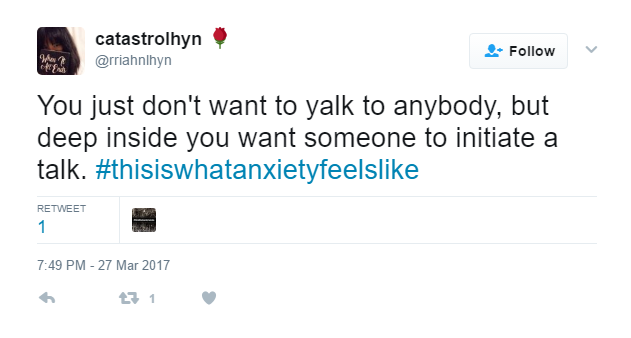
- This tweet from someone on the feed:

- having to explain my thought process, like why I checked with a friend that it was really them I waved to on the road a year ago, and feeling like that explanation makes me sound insane
- talking too much. All. The. Time.
- physical symptoms: headaches, stomachaches, back pain, shoulder pain
- not explaining things to my friends because I'm afraid they'll judge me
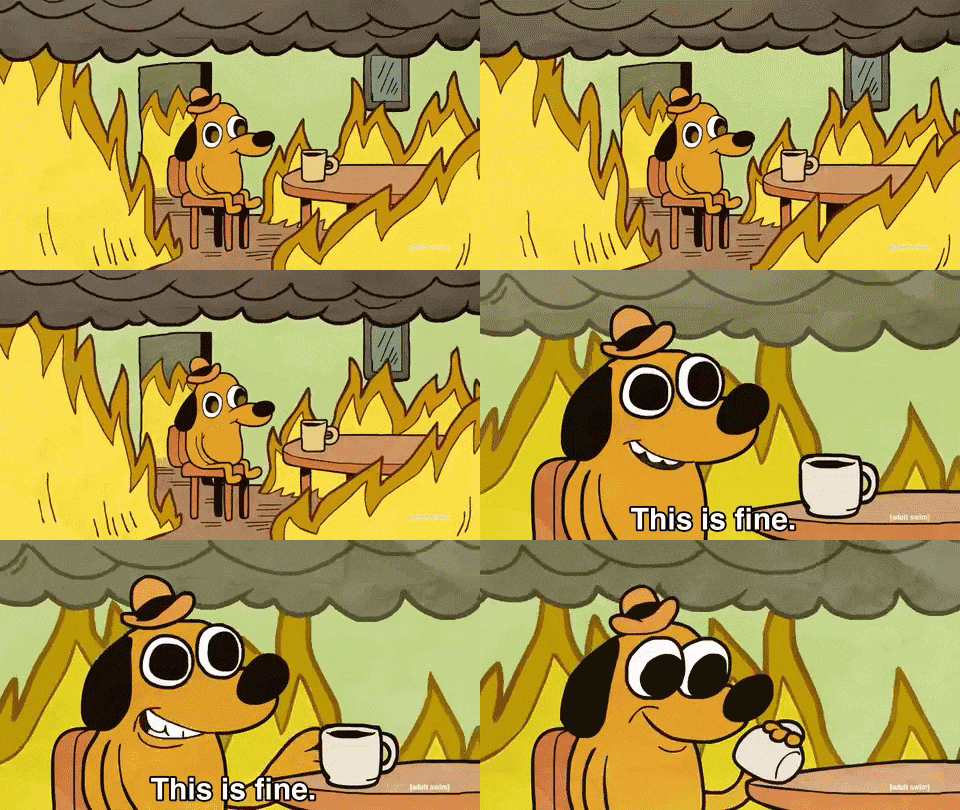
- worrying that they'll think it's nothing. or for attention:

- finally working up the courage to tell someone, then feeling guilty when they said they had no idea and ending up apologizing for not telling them
- feeling guilty anytime I talk about it since I told someone, like they'll get sick of me; feeling guilty because that's all I want to talk about now that I've broken through the initial fear
- wishing that I wasn't such a mess, that I could keep myself together instead of needing other people to help
- worrying that my husband will get sick of dealing with my mental health issues and leave
- telling him this and having him comfort me and promise it'll never happen, which somehow makes it worse
- knowing that I probably need to see a counselor, but being unable to pick up the phone and start that process
- Writing, no matter how small:

- losing hobbies I once loved because I'm scared that I won't like that book when I start it.
- struggling to play video games on bad days because the stress makes me susceptible to severe motion sickness
- correcting this post like six times to make sure it's perfect.


Overall, I'm pretty lucky. Bishop knows by now when I'm having a shitty day, and he'll take care of me -- snuggle me, get me food, make all the decisions, whatever it takes. The one friend I trusted to tell pushes me to talk, won't let me hide and say I'm fine when I am obviously not (and gives me a hug when I start crying, which is usually what I need more than any words).
I have the resources to get counseling if I ever manage to get myself together enough to do it. I've pushed myself hard enough to have a new career waiting just beyond the horizon.
I am doing well. Everything could be so much worse, and I have come out the other side of this knowing I am so much stronger than I thought I could ever be.
I worry that it'll happen again, that my career change won't truly alleviate what I feel now and I'll end up just as unhappy. My friend at work keeps telling me that I have to make choices based on my own happiness, and he's right. But there is safety where I am now. I know how being unhappy here feels, and as sick as it is, I am used to it. Changing my life means opening myself up to something new, something that could be good and could be terrible. I'm willing to make the leap, and I'm ready, and yet that little voice is still lingering in the back of my mind, wondering if this is really the right move.
#ThisisWhatAnxietyFeelsLike
Saturday, March 18, 2017
Andromeda: First Impressions
This long-awaited day has finally come: Mass Effect: Andromeda opened for 10-hour trial play. This remains in anticipation of its full release next week on the 21st, when the story will finally make a full appearance.
If you thought a fangirl like me would wait to post until then, you were sadly mistaken.
However, like so many other big-name releases in years past, Andromeda is not without its detractors, nor its issues. There are bugs in animation, in gameplay, awkward menus, and talk of a day-one patch long before the trial ever opened to Origin Access subscribers. This, for whatever reason, is sending the video game critics into a frantic tailspin.
I'm not totally sure why. Maybe because it's been five years since ME3? Maybe because EA marketed the shit outta this game online, so more people than ever are aware and pre-ordering and paying attention? I'm not sure -- I joined the video game scene long after ME3 had come out and disappointed so many of its fans, and to this day, I'm one of the only people I know who worships the ending of ME3 (it's beautiful and tragic and I love it). And when DAI came out, I was plugged in but not so heavily since I didn't enjoy DA2.
So I've never experienced anything like this.
Nevertheless, let me explain why it doesn't bother me: Andromeda, from what I've seen so far, is good.
I admit, I haven't touched the single player campaign at all. After reading some reviews and learning that it stops the campaign at a crucial moment -- right when it's about to get amazing, from what I understand -- I decided not to spoil it until I can play past it. Good stories take time to get off the ground, something the gaming industry doesn't seem to understand, and I don't want to get bogged down in frustration waiting the extra days until I can continue it.
Plus, I took the 21st off from work specifically to play, so I'll have time.
The single player campaign is also the subject of much scrutiny and derision online. No doubt if you follow pcgamer, IGN, and others, you'll have seen some of the headlines: "Why I Hate ME: Andromeda's Planet Scanning System" comes to mind, as does "The Internet is Brutally Mocking ME: Andromeda's Animations" (these are direct quotes from PC Gamer - not exactly objective reviews).
Some authors seem like they have a bone to pick with the series. The guy who hates the scanning system, for example, is irritated that you can't drive the Nomad up a vertical cliff without shifting into 6-wheel mode, something akin to 4 wheel drive in modern SUVs. This seems a) realistic, to have to change modes for different terrain, and b) incredibly nitpicky. When has the vehicle system in Mass Effect ever been good? The characters even make fun of it in the ME3: Citadel DLC, it's so bad. And really, you can't drive up a vertical cliff? Maybe the game didn't mean for you to go that way.
But rants about video game critics aside (which is an essay unto itself), there do seem to be some actual issues with animation, including poorly animated faces and bugs with character movement. They are things that might drive away critics, and perhaps even some incoming fans, but to me, it's not that bad. No faces I've seen are missing half their skin a la Assassin's Creed Unity, nor so badly rendered that they are collapsing into piles of skin and clothing, or falling through the floors at random.
Instead, you get moments like this:
Frankly, this is hilarious. I've been walking around my basement like this for two days, it amuses me so much. So does this:

This is like they made a ballerina into a colonist! It's awesome! I get that that's probably not what the programmers were going for, but I love it anyway.
Some errors I frankly wonder how people missed in previous games, like this one of poor Cora...

... which gets compared to a gorilla walking away. Okay, yes, this is hilarious too. But it's not new! The female Inquisitor in DAI walks just like that all the time, stomping all over Skyhold like a water buffalo. I can't imagine being so annoyed over it that I wouldn't play, or that I'd cancel my pre-order, or anything else.
And Sara Ryder's giant toothy smile is just adorable, let's be honest.

I realize that I haven't played the campaign yet, so maybe this is more intrusive than I think. But if there's a good story, and if the characters are as developed and interesting as always, and I can crush the ever-living shit out of whatever enemies stand in my way, I don't foresee any real issues. I'm not playing for the animation, after all.
Once you get over the animation, the reports of cheesy dialogue are, frankly, a non-issue. The Mass Effect stories have always been incredibly well-written: They are massive and far-reaching, have great continuity, and clearly the writers devote hours into putting all those puzzle pieces together.
But the dialogue has never been Shakespeare.
I spent hours in-game searching for great quotes from Shepard a few years back, when I got my Mass Effect tattoo. I'm covered in quotes from books, movies, philosophers, etc, and I thought Shepard might have something profound to add to this. Nope. I ended up with an N7 tattoo I adore, and that fits the spirit of the series, far better than "I should go" ever could.
Nor, frankly, was the animation ever that amazing. One walk into the battery to talk to Garrus, only to have him turn his head around Exorcist-style just to say "Can it wait for a bit? I'm in the middle of the calibrations?" was enough to know that.
Don't believe me? Just watch Shepard dance:
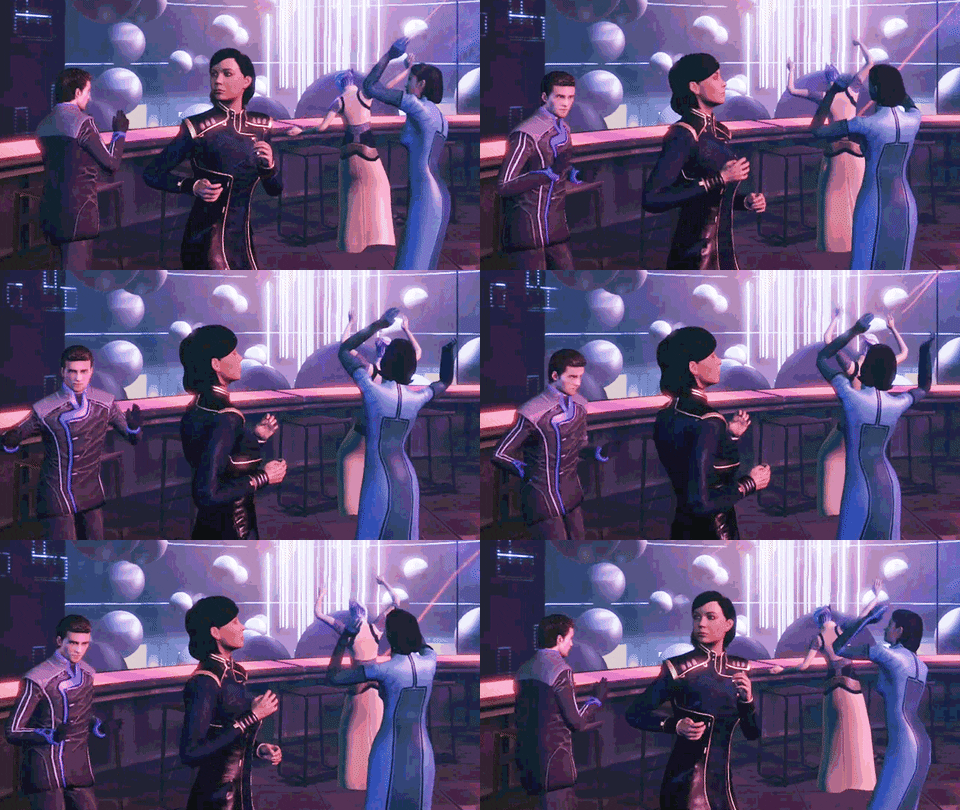
So I'm not passing judgment based on some animation issues. I want the GAME, not some critic's issues with it.
Nor have I maxed out my 10 hours on multiplayer, but I'm getting close. And that... whew. That might be worth the money in and of itself -- it's awe-inspiring. It's fast-paced and brutal, full of challenges and new enemies, and some stunning new combat effects that frankly, I am having a ton of fun playing. Every time I jet-pack over some destructive enemy, only to drop a biotic punch on them that reverberates through the field, I absolutely adore it.
I've seen criticism here too, and again, I'm not sure what people were truly expecting. It's often the same set-up as the ME3 multiplayer: cooperative teams fighting waves of enemies, each wave tougher than the last. There are a mix of hacking, disruption, and survival goals, and as before, having a mix of races and classes offers you the best chance for success.
Bioware has also eliminated the part that made ME3's multiplayer so irritating: It is no longer mandatory, and instead a way to earn additional points, tech, and rewards should you be so inclined.
Then again, I don't play FPS online games like CoD or Battlefield or anything else. FPSs make me motion sick, so there's that, but I also don't like the attitude of noobs vs. people with too much time on their hands vs. casual gamers; I prefer the cooperative aspect in ME where I don't have to be the best to enjoy myself. This gives me the chance to play with others, to explore incredible combat styles, and still have fun. To me, that's the best of all worlds.
Sure, there are opportunities for microtransactions, and the multiplayer menus aren't the easiest to navigate, and of course, playing the maps without knowing anything about the enemies you're fighting from in-game experience makes things difficult. But no game, no matter the time investment of the developers or its fans, is without flaws. I don't expect it to be.
It helps that it's fabulously fun to play. When I can do THIS...

... and take some enemy out, I don't really care if there are micro-transactions or difficulties muting other players. I just wanna crush a bitch and get up for the next wave.
Get ready: Only 3 days until we hit Andromeda.
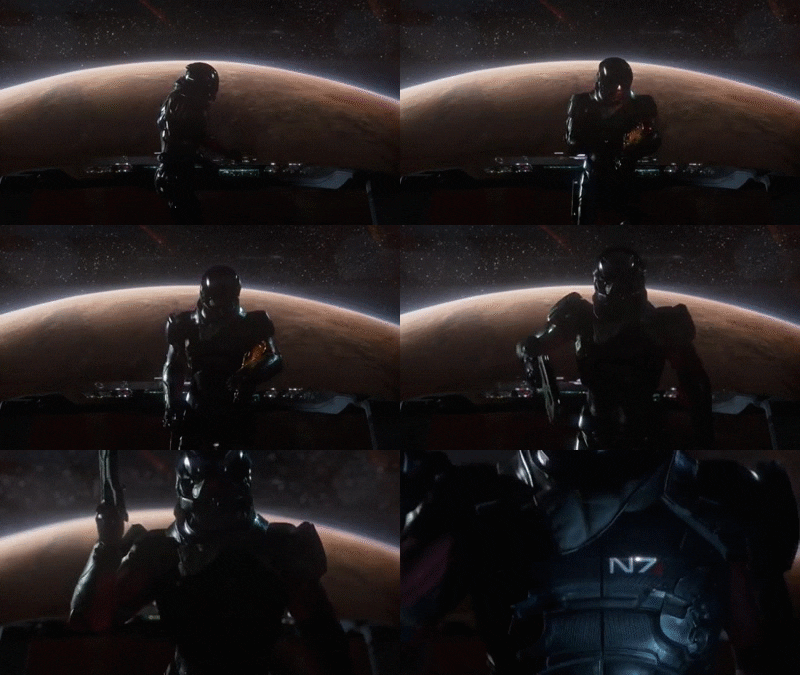
If you thought a fangirl like me would wait to post until then, you were sadly mistaken.
 |
| It's here! I don't care how many days until I get the full game! |
I'm not totally sure why. Maybe because it's been five years since ME3? Maybe because EA marketed the shit outta this game online, so more people than ever are aware and pre-ordering and paying attention? I'm not sure -- I joined the video game scene long after ME3 had come out and disappointed so many of its fans, and to this day, I'm one of the only people I know who worships the ending of ME3 (it's beautiful and tragic and I love it). And when DAI came out, I was plugged in but not so heavily since I didn't enjoy DA2.
So I've never experienced anything like this.
Nevertheless, let me explain why it doesn't bother me: Andromeda, from what I've seen so far, is good.
I admit, I haven't touched the single player campaign at all. After reading some reviews and learning that it stops the campaign at a crucial moment -- right when it's about to get amazing, from what I understand -- I decided not to spoil it until I can play past it. Good stories take time to get off the ground, something the gaming industry doesn't seem to understand, and I don't want to get bogged down in frustration waiting the extra days until I can continue it.
Plus, I took the 21st off from work specifically to play, so I'll have time.
The single player campaign is also the subject of much scrutiny and derision online. No doubt if you follow pcgamer, IGN, and others, you'll have seen some of the headlines: "Why I Hate ME: Andromeda's Planet Scanning System" comes to mind, as does "The Internet is Brutally Mocking ME: Andromeda's Animations" (these are direct quotes from PC Gamer - not exactly objective reviews).
Some authors seem like they have a bone to pick with the series. The guy who hates the scanning system, for example, is irritated that you can't drive the Nomad up a vertical cliff without shifting into 6-wheel mode, something akin to 4 wheel drive in modern SUVs. This seems a) realistic, to have to change modes for different terrain, and b) incredibly nitpicky. When has the vehicle system in Mass Effect ever been good? The characters even make fun of it in the ME3: Citadel DLC, it's so bad. And really, you can't drive up a vertical cliff? Maybe the game didn't mean for you to go that way.
But rants about video game critics aside (which is an essay unto itself), there do seem to be some actual issues with animation, including poorly animated faces and bugs with character movement. They are things that might drive away critics, and perhaps even some incoming fans, but to me, it's not that bad. No faces I've seen are missing half their skin a la Assassin's Creed Unity, nor so badly rendered that they are collapsing into piles of skin and clothing, or falling through the floors at random.
Instead, you get moments like this:
Frankly, this is hilarious. I've been walking around my basement like this for two days, it amuses me so much. So does this:
This is like they made a ballerina into a colonist! It's awesome! I get that that's probably not what the programmers were going for, but I love it anyway.
Some errors I frankly wonder how people missed in previous games, like this one of poor Cora...
... which gets compared to a gorilla walking away. Okay, yes, this is hilarious too. But it's not new! The female Inquisitor in DAI walks just like that all the time, stomping all over Skyhold like a water buffalo. I can't imagine being so annoyed over it that I wouldn't play, or that I'd cancel my pre-order, or anything else.
And Sara Ryder's giant toothy smile is just adorable, let's be honest.
I realize that I haven't played the campaign yet, so maybe this is more intrusive than I think. But if there's a good story, and if the characters are as developed and interesting as always, and I can crush the ever-living shit out of whatever enemies stand in my way, I don't foresee any real issues. I'm not playing for the animation, after all.
Once you get over the animation, the reports of cheesy dialogue are, frankly, a non-issue. The Mass Effect stories have always been incredibly well-written: They are massive and far-reaching, have great continuity, and clearly the writers devote hours into putting all those puzzle pieces together.
But the dialogue has never been Shakespeare.
I spent hours in-game searching for great quotes from Shepard a few years back, when I got my Mass Effect tattoo. I'm covered in quotes from books, movies, philosophers, etc, and I thought Shepard might have something profound to add to this. Nope. I ended up with an N7 tattoo I adore, and that fits the spirit of the series, far better than "I should go" ever could.
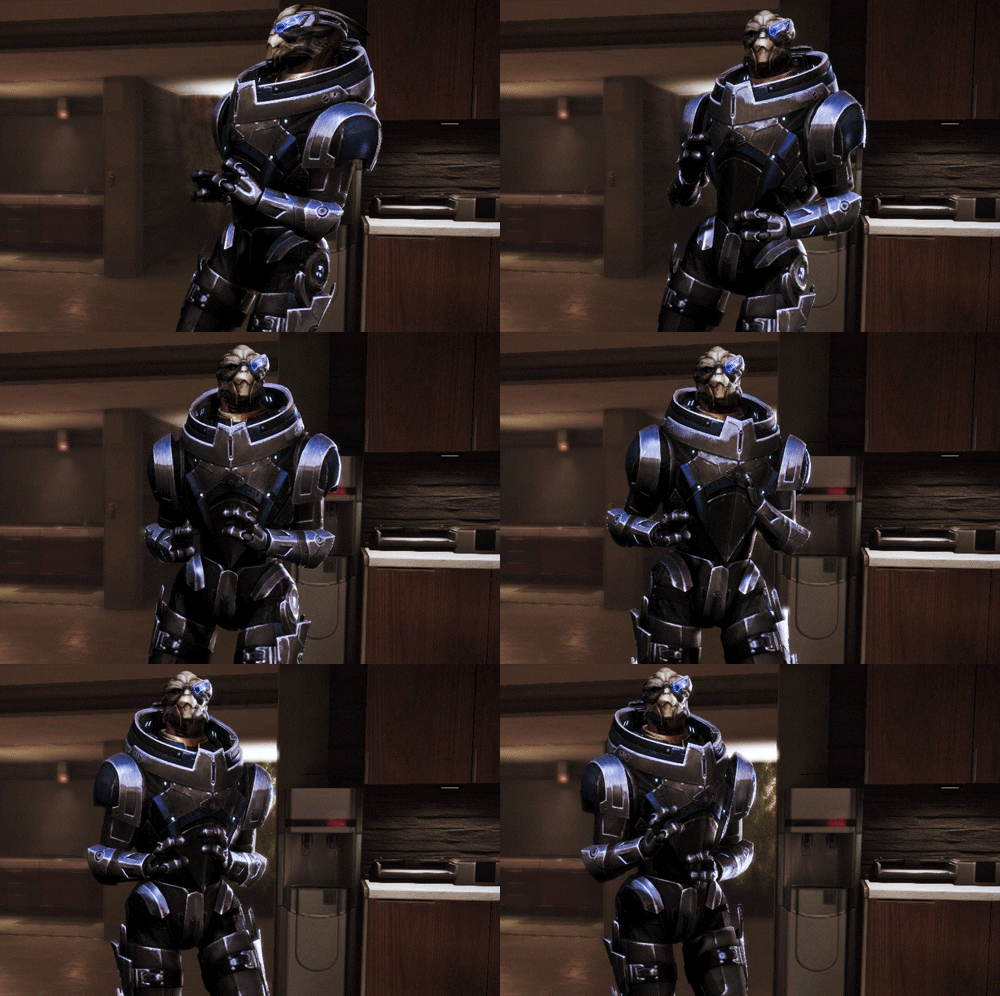
Nor, frankly, was the animation ever that amazing. One walk into the battery to talk to Garrus, only to have him turn his head around Exorcist-style just to say "Can it wait for a bit? I'm in the middle of the calibrations?" was enough to know that.
Don't believe me? Just watch Shepard dance:
So I'm not passing judgment based on some animation issues. I want the GAME, not some critic's issues with it.
Nor have I maxed out my 10 hours on multiplayer, but I'm getting close. And that... whew. That might be worth the money in and of itself -- it's awe-inspiring. It's fast-paced and brutal, full of challenges and new enemies, and some stunning new combat effects that frankly, I am having a ton of fun playing. Every time I jet-pack over some destructive enemy, only to drop a biotic punch on them that reverberates through the field, I absolutely adore it.
I've seen criticism here too, and again, I'm not sure what people were truly expecting. It's often the same set-up as the ME3 multiplayer: cooperative teams fighting waves of enemies, each wave tougher than the last. There are a mix of hacking, disruption, and survival goals, and as before, having a mix of races and classes offers you the best chance for success.
Bioware has also eliminated the part that made ME3's multiplayer so irritating: It is no longer mandatory, and instead a way to earn additional points, tech, and rewards should you be so inclined.
Then again, I don't play FPS online games like CoD or Battlefield or anything else. FPSs make me motion sick, so there's that, but I also don't like the attitude of noobs vs. people with too much time on their hands vs. casual gamers; I prefer the cooperative aspect in ME where I don't have to be the best to enjoy myself. This gives me the chance to play with others, to explore incredible combat styles, and still have fun. To me, that's the best of all worlds.
Sure, there are opportunities for microtransactions, and the multiplayer menus aren't the easiest to navigate, and of course, playing the maps without knowing anything about the enemies you're fighting from in-game experience makes things difficult. But no game, no matter the time investment of the developers or its fans, is without flaws. I don't expect it to be.
It helps that it's fabulously fun to play. When I can do THIS...
... and take some enemy out, I don't really care if there are micro-transactions or difficulties muting other players. I just wanna crush a bitch and get up for the next wave.
Get ready: Only 3 days until we hit Andromeda.
Monday, February 13, 2017
The Evolution of Jurassic World, part 2
Let’s face it: Neither of the two movies between Jurassic Park and
Jurassic World are particularly good.
They’re marginally entertaining, sure – I own them all and it is
with slight shame that I admit that I’ve seen each one at least a dozen times.
But they aren’t good – they aren’t well written, they aren’t very well acted,
and really, the plots are just a little too ridiculous to lend themselves to
good filmmaking.
That’s all what I’ve come to expect from sequels in general, so I
guess in that respect they’re about on par with other movies.
The bigger issue is this: Neither The Lost World nor Jurassic Park
III have the ethical questions built into them that Jurassic Park does; they in
fact barely even touch on them. They
aren’t as frightening or intrinsically precarious, nor are they as profound.
Jurassic World, however, is a step back toward the 1993
original.

I will note now: I’m going to try not to spoil anything in
general, and I guarantee I will not spoil the big twists of the movie. I can’t guarantee no spoilers overall simply
because I’m not sure what everyone would consider a spoiler, but also because
it’s been over a year since Jurassic World hit theatres. After that long, spoilers don’t count anymore
J
First let me say this: there’s no question that Jurassic World is
a successful movie. It made a disgusting
amount of money -- according to boxofficemojo.com, more than $1.6 billion
dollars worldwide. And while it has a 72%
on Rotten Tomatoes from critics, viewers gave it nearly 80%. That’s not amazing like Mad Max, but it ain’t
bad either. If anything, the numbers
indicate a stunning draw for the general public around the world.
Maybe it’s not the best movie ever, but the highest-earning, most
fun movies are never Oscar winners.
Fun is a big thing for Jurassic World. It’s reasonably well-written, lots of good
one-liners even if the characters aren’t exactly dynamic. And even though you
can predict the plot twists a mile coming, they’re still entertaining and fun to watch.
Bryce Dallas Howard isn’t great on her own, as most of us who have
seen The Village were already aware, but she sets up some of the best lines in
the film. The symbolic value of her
hair, straight and perfect at the beginning and curling gradually as she accepts
that she’s no longer in control of the park, gives a visual representation of
the themes the movie is trying to deal with, which I personally find
hilarious.
And Chris Pratt, a much stronger actor than I gave him credit for,
really carries the movie. As I watched,
I developed an appreciation for him as an actual ACTOR that I never had before
(though I can’t discount his comedic abilities on Parks and Recreation nor his
abs in Guardians of the Galaxy). He
gives Owen Grady just the right blend of seriousness and sardonic wit, so even
when he delivers that last super-cheesy line about staying together for
survival, you can’t help but smile along.
My husband and I quote Pratt’s “I was in the Navy, not that
Navajo!” line now whenever we’re trying to find something, and the clip below
remains one of my favorite Easter egg moments in film:

There is plenty here to pay homage to the films that came before it,
most especially the original, and that awareness of its origins showcases the
writers’ abilities as well as sets it up as a sequel instead of a complete
remake.
Really, the biggest problem with Jurassic World lies in its
theme.
The movie is littered with hints of depth – Chris Pratt and Bryce
Dallas Howard are constantly bickering about control, a throwback to the
ethical dilemmas of the first movie, and the dinosaurs’ genders are constantly
mixed up, hinting at the male normativity that infiltrates American
society. But Jurassic World never delivers on that depth, and that’s what
truly sets it as a worse film than the original.
The recurring quips and side remarks about control, for example,
are strong allusions to the conversations about control from the first
movie. But when they aren’t followed up
by that conversation itself, they lose some of their power. Plus, since most of those quips take place
between Howard and Pratt, who are also batting around a low-simmering if
obligatory sexual tension, that conversation about control becomes a commentary
about male and female dynamics; that’s infinitely less deep considering that
basically all romantic comedies have that exact same commentary.
And yes, the InGen guys are constantly messing up the sex of the
raptors. Everyone else – everyone who respects
the raptors, no surprise – keeps correcting them too, and that’s all great for
starting a dialogue on how masculine normativity is inherent and
problematic. Except that dialogue never
happens, and instead everyone who calls the raptors male instead of female just
gets eaten. Not exactly subtle.
Now: I realize that, in part 1 of this essay, I talked about how
being eaten serves those who want to exploit the raptors perfectly. That's pretty contradictory to what I said
here about Jurassic World, but hear me out:
If that conversation about ethics is built into the movie, as it is in
Jurassic Park, then it's fine to have the Rex eat them later. But in Jurassic World, the bad guys getting
eaten IS the conversation, and that's not nearly enough.

There is, again, the start of the conversation about extinct
animal rights, both as weaponry and as product placement. The sponsorship of the Indomitus Rex by
Verizon Wireless is only the beginning, as Lowery, the tech guy, notes to Claire
early on. And of course Hoskins wants to
recreate military tech into animal support, which is an interesting if
misguided thought, as Owen doesn’t hesitate to point out. All of these discussions again reflect the
original movie.
In both Jurassic Park and Jurassic World, there is always someone
to remind us that these dinosaurs are actually animals. No matter how people – either us or those
on-screen – choose to look at them, they will remain animals. That includes their instincts and impulses, and
no amount of training can “suppress 65 million years of gut instinct,” as Grant
puts it. Humans can’t control them, no
matter how pretty the illusion might be.
But while Jurassic Park spends tens of minutes -- an eternity in movie-time
-- actually discussing this, long before the power goes out and chaos ensues,
Jurassic World never quite gets there.
It will forever be below its original for that reason, and even if I
understand that its writers weren’t trying to just remake the original, it’s
still a drawback.
The CGI nature of this film fits right into this issue. Where Jurassic Park used so many real-life
models, thanks to Stan Winston, Jurassic World uses almost entirely CGI, and no
matter how carefully integrated, CGI changes things. When the T-Rex headbutts Lara Dern and she
screams as she smashes sideways, when the glass roof on the car shatters as the
Rex dives after the kids, those moments are real in ways that the Indomitus Rex
biting the gyroscope in Jurassic World just can’t be.
Despite all this, I loved this movie.
It’s just so fun – and trying so hard to be deep that I have to
give it some credit. There are moments
where I had to cringe at the lack of subtext, but there are also moments where
I genuinely jumped or laughed. It’s
paced well, especially for a big-budget, 2-hour movie, and in fact I could have
used about 10 more minutes of Pratt
riding his motorcycle with the raptors. And the ending… sure, it’s predictable,
but it’s fun, and if a movie handles
something well, I just can’t argue that the mere predictability of it will ruin
the fun. :) It sure didn't here.

I've seen it probably six or seven times by now, and I’m sure it
has many more viewings to come in my household. Could it have used a
little pause for the conversations its writers clearly wanted to start and did
not follow through? Yes, definitely. However, and more importantly: it
does the first film justice, and I could not ask for a better continuation of a
story that I have adored since the start.
Subscribe to:
Posts (Atom)